
Did You Know?
We serve loans, the best way you can borrow
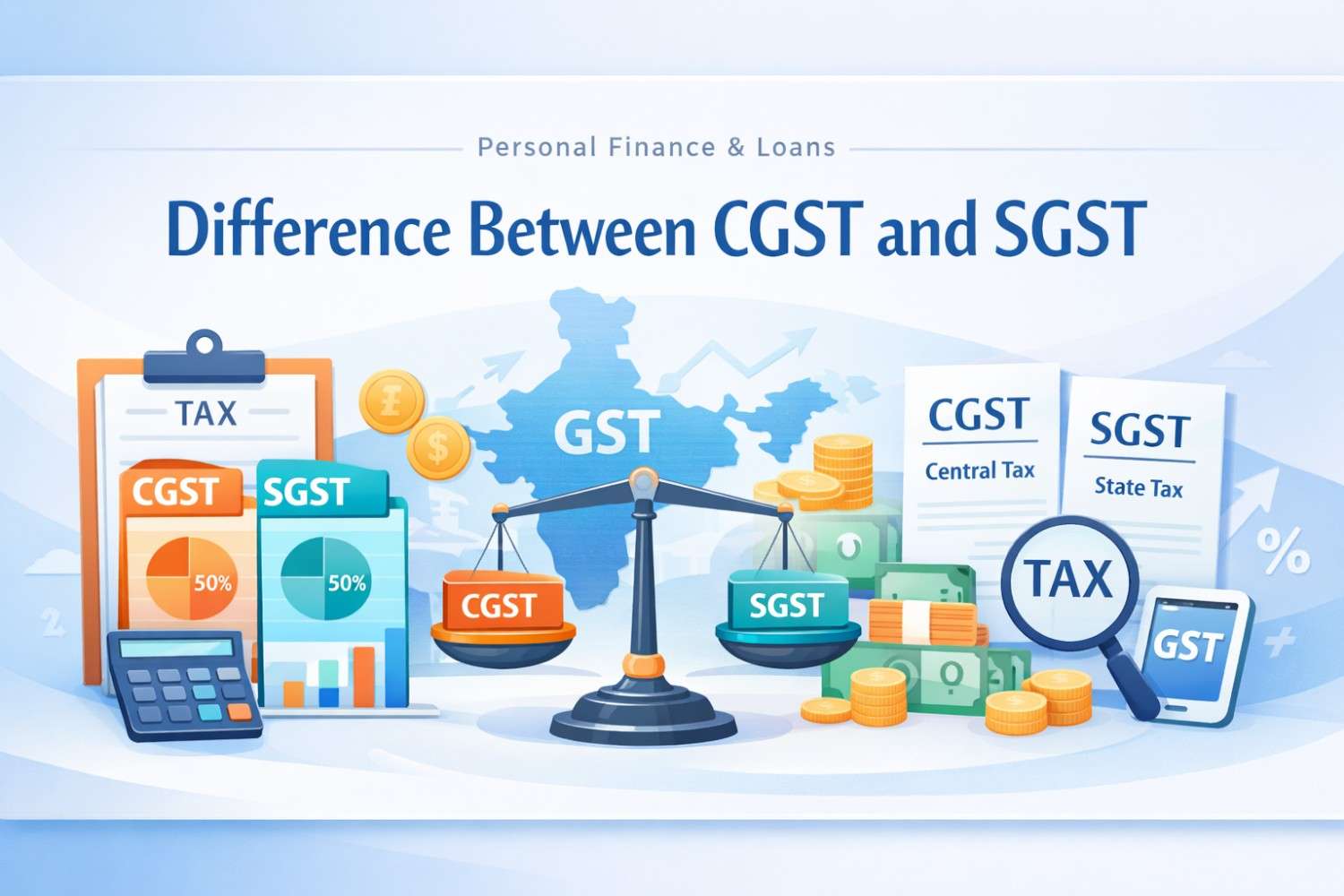

Every time you buy products or professional services within your state, your bill includes two specific tax components – CGST & State GST. The main difference between CGST and SGST is in the authority that imposes them. The central government administers CGST. On the other hand, the state government administers SGST.
This dual structure allows both administrations to share tax earnings equally from a single transaction. It keeps revenue flows balanced (which is essential for a growing economy) & ensures that both governments have funds to operate.
The CGST and SGST full form is Central Goods and Services Tax and State Goods and Services Tax. CGST represents the portion of the tax that goes directly to the Central Government. It allows the Centre to claim its share of revenue from intra-state trades- basically any time you buy or sell things within the same state boundaries.
The tax you pay splits right down the middle between the state and the central authorities. Take an example. Suppose you buy furniture worth Rs 10000 in Jaipur. It comes with an 18% GST rate. Your total tax bill is Rs 1800.
You pay Rs 900 to the Centre as CGST and the remaining Rs 900 goes to the State as SGST. The Central Government uses this CGST money to fund massive national projects, such as building highways, operating railways, strengthening defence, and running healthcare missions that benefit everyone across the country.
Imagine you are a business owner selling a gadget for Rs 12000. If the tax rate for that item is 18%, the total GST amount reaches Rs 2160. Since this is an intra-state sale, you must divide this total into two equal parts for the Centre and the State. To find how to calculate CGST and SGST, you simply take half of the total tax; in this case, Rs 1080 (which is 9% of Rs 12000) becomes the CGST.
When you supply goods or offer services inside state lines, you must list both CGST and SGST on your invoice. As the supplier, you are responsible for collecting the CGST and depositing it with the central treasury. The central government then shares some of this revenue back with the state where the supply occurred (under specific financial rules). Your CGST calculation depends entirely on the total transaction value, including any previously paid duties or taxes.
SGST stands for State Goods and Services Tax. This is the tax portion that your local State Government collects for its own budget. It applies to the exact same local transactions as CGST but the money stays within the state where the sale actually took place.
If you buy sugar for Rs 5000 in Bengaluru with a 5% GST, the total tax is Rs 250. Here, you send Rs 125 to the Centre as CGST and the other Rs 125 goes to the Karnataka State Government as SGST.
States use SGST revenue to fund local needs, such as repairing city roads, funding schools, managing water systems, and building hospitals. Essentially, every time you shop locally, you pay two taxes at once, even if they appear as one combined rate on your final receipt.
Suppose you own a cake shop in Delhi and sell a custom cake to a local resident for Rs 10000. Cakes usually attract a 5% CGST and SGST percentage. This means the SGST part is exactly 2.5% (half of the 5% total). You would charge your customer Rs 250 for SGST, which goes directly to the Delhi state government.
You have to charge both CGST and SGST on the bill whenever you give services or goods within your state. You are then responsible for making sure that SGST reaches the state government’s accounts correctly. The state uses these funds to improve local infrastructure and public welfare. You calculate this tax based on the final value of the goods or services after considering all other applicable duties or costs involved in the sale.
Here is a quick breakdown of the difference between CGST and SGST that you should keep in mind as a responsible taxpayer –
| Features | CGST | SGST | Full Name | Central Goods and Services Tax | State Goods and Services Tax | Taxing Body | Central Government | State Government | Collection Body | Central Government | State Government | Application | Intra-state supply (Within state) | Intra-state supply (Within state) | Revenue Usage | Central government shares with states | State government keeps the entire share | Tax Split | 50% of the total GST rate | 50% of the total GST rate | Record Keeping | Mentioned separately in GST returns | Mentioned separately in GST returns | Collection Way | Supplier collects from the buyer | Supplier collects from the buyer | Mandatory Sign-up | Required if turnover hits Rs 20 lakh (Rs 10 lakh for NE states) | Required if turnover hits Rs 20 lakh (Rs 10 lakh for NE states) |
|---|
CGST and SGST directly affect how you run your business, your paperwork, and your overall profit margins. Every single invoice and tax return you handle must show this dual tax nature accurately to stay compliant.
Impact on Businesses
Impact on Consumers
You should consider these vital factors to stay on the right side of the law –
CGST and SGST will be levied on the following people and businesses –
Key Points
Also Read: Impact of GST on Personal Loan
The Central Government administers the CGST (while State Governments administer the SGST). These taxes apply whenever goods or services move within a single state. The Centre collects the CGST portion, and the state collects the SGST share. Now you know what is CGST and SGST & you can file your returns correctly and avoid penalties.
CGST and SGST are the two parts of the Goods and Services Tax applied to local sales. CGST goes to the central government, and SGST goes to your state government. They replaced older taxes, such as VAT and Service Tax. You see them on almost every local receipt you get. They ensure both governments get revenue from a single transaction.
The primary difference is the authority that collects the money. You pay CGST to the Central Government of India. You pay SGST to the State Government where the purchase is made. While both apply to the same sale, the revenue helps fund different government levels’ projects. Both usually carry the same tax rate (half of the total).
These taxes apply when the location of the supplier and the place of supply are in the same state. This is called an intra-state transaction. If you buy a phone in Mumbai from a seller in Mumbai, you pay both. However, if the seller is in a different state, you pay IGST instead. They are strictly for local trade.
The distribution is a simple 50-50 split. 9% goes to the Centre as CGST and 9% goes to the State as SGST if a product has an 18% GST rate. The law ensures that neither government loses out on its fair share. This equal division helps maintain financial balance between the central authority and individual states for regional development.
Yes, they are always equal. Suppose the total GST rate for a service is 12%. The CGST and SGST will each be 6%. You will never see a transaction where these two rates differ for the same item. This symmetry makes it easier for you to calculate your taxes and simplifies your business’s accounting process.
The GST Council decides these rates. This council includes representatives from the Central Government and all State Governments. They meet regularly to move items into different tax brackets, such as 5%, 12%, 18%, 28%. They aim to keep the goods affordable for you. At the same time, they also ensure the government collects enough revenue. Their decisions apply across the entire country.
As a registered business owner or supplier, you are responsible for collecting the tax from your customers. You then deposit this amount with the respective governments. While the consumer ultimately bears the cost of the tax, the legal duty to file returns and pay the government lies with the seller. You must ensure your personal loan eligibility criteria and records are clean.
Yes, they are always charged together on the same invoice for intra-state sales. You cannot charge one without the other. They appear as separate line items on your bill so you can see exactly where your money is going. This dual levy system is the foundation of the current Indian indirect tax structure. It ensures a transparent tax collection process.
As a consumer, you pay them as part of your total bill. You don’t have to make separate payments to different departments. The shopkeeper or service provider collects the total amount from you and handles the split behind the scenes. Your only job is to check the invoice to ensure the rates are correct and that you aren’t paying extra fees.
You can claim a refund under certain conditions, such as an inverted duty structure or excess balance in your electronic cash ledger. If you export goods or have unutilised input tax credit, you might be eligible for a refund from the tax department. You must file the correct forms and provide proof of your transactions to get your money back.
Download our personal loan app to apply for a personal loan. Get up to 2Lakhs* as a personal loan. Download Now!


Sign into avail a personal loan up to ₹ 2,50,000

Unifinz Capital India Limited is a Non Banking Finance Company (NBFC) registered with the Reserve Bank of India (RBI). lendingplate is the brand name under which the company conducts its lending operations and specialises in meeting customer’s instant financial needs.
















 RBI CMS
 RBI Sachet


