
Did You Know?
We serve loans, the best way you can borrow
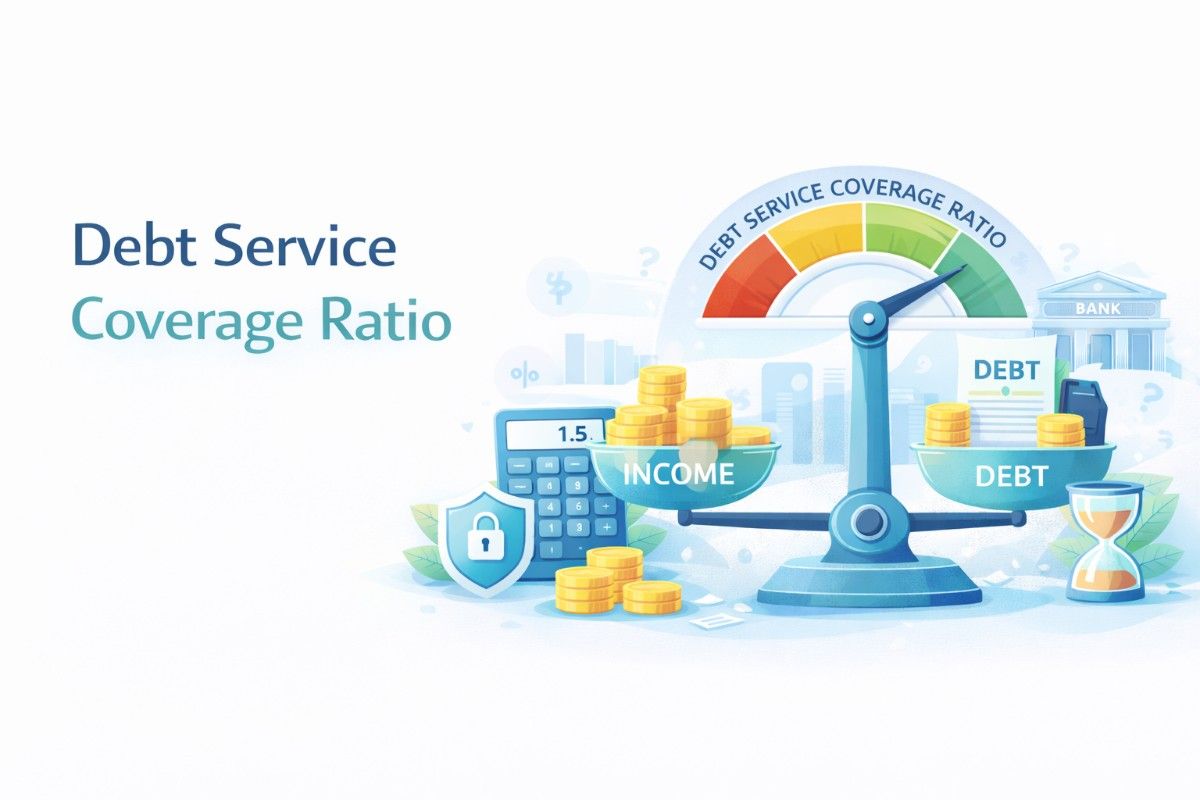

The debt service coverage ratio stands as a vital aspect for your business’s finances. It measures whether your operating income can cover your upcoming repayments. You use this metric to weigh your available cash against the total weight of your interest, principal, and lease costs.
In the world of commercial finance, lenders lean on this figure to gauge your credit risk before they hand over any funds. You calculate this by dividing your net operating income by your total debt obligations. If you see a result higher than 1, you have enough cash to cover your bills.
A result below 1 means you aren’t bringing in enough money to pay the lenders back (which is a red flag). If you are looking for a business loan, most lenders will want to see you stay well above that 1.0 mark.
Think of the debt service coverage ratio formula as a simple balance –
(Available Cash +/- Adjustments) / (Interest + Principal)
Most professionals use EBITDA as the starting point for their cash flow.
While specific tweaks depend on your industry, the standard debt service coverage ratio formula looks like this –
Debt Service Coverage Ratio = (EBITDA – Cash Taxes) / (Interest + Principal)
EBITDA – This is your earnings before interest, tax, depreciation, and amortisation.
Principal – The actual loan amount you must pay back within the year (your current portion of long-term debt).
Interest – The total interest cost you owe on both short-term loans and long-term loans.
Cash Taxes – The actual tax amount you pay in cash during the year.
The debt service coverage ratio relies on two main pillars – your net operating income and your total debt service.
To find your ratio, you just divide the first by the second.
Let’s look at what actually goes into these two categories –
1. Net operating income – This represents the cash your business generates from its daily work. You take your revenue and subtract operating costs. This happens before you pay interest or taxes. It usually matches your EBIT.
2. Total debt service – This covers every penny you owe to lenders in a twelve-month window. It includes interest, principal, and even sinking fund payments. You will find these listed on your balance sheet as current liabilities. Your specific market often dictates how you structure these repayments.
You should know that debt service coverage ratio comes in a few different flavours depending on the timeframe you need.
1. Periodic DSCR – You calculate this for a specific window, like a single quarter or a half-year. It is common when dealing with development banks or bonds.
2. Annual ADSCR – This is the same idea but covers a full 12-month stretch. It helps you smooth out seasonal highs and lows in your cash flow.
3. Historical vs. Forward-Looking – You might look at the HDSCR to see how you performed in the past. Alternatively, you use the FDSCR to project your future ability to pay based on your budget forecasts.
Learning how to calculate debt service coverage ratio is quite simple because it only needs two sets of numbers.
You can even set up a debt service coverage ratio formula in excel to track it monthly. The basic math is –
DSCR = Net Operating Income / Annual Debt Service
Your net operating income is your pre-tax income minus things like rent, wages, and COGS. Some people prefer using EBITDA (pre-tax income + interest + depreciation + amortisation) for a clearer view of cash. Your annual debt service is just the sum of all principal and interest due right now.
Imagine your net operating income is Rs 5000000. Your annual interest is Rs 1000000 and your principal is Rs 1500000.
DSCR = 5000000 / (1000000 + 1500000) = 2
This debt service coverage ratio example shows you have twice the income needed to cover your debts. You are in a very safe spot.
At its core, this ratio tells you if your business is actually sustainable. You can use it to decide if you should take on debt financing or maybe issue bonds instead. If you go the bond route, this ratio helps you set the right interest rate. Here is how different people use it –
1. Strategy – You can use your ratio to see if you have the “room” to expand or if you need to stay lean.
2. Capital Structure – It helps you find the right mix of debt and equity. If your DSCR is low, you might need to raise money through equity to avoid drowning in repayments.
3. Investing – Investors check this to make sure their dividends are safe. They want to see that you have cash left over after the bank takes its cut.
4. Loan Eligibility – Lenders use this to decide if you are a “safe bet.” It is the first thing they look at when you apply.
5. Performance – When you look at this alongside your liquidity, you get a full picture of your long-term survival chances.
Your debt service coverage ratio acts as a gateway to better financial opportunities. If you keep it healthy, you get better deals. Here is why it matters for your growth –
1. Better Loan Terms – To get a standard bank loan, you usually need a ratio of 1.1 or higher. High scores mean lower interest rates and less stress.
2. Real Estate Perks – If you invest in property, some lenders offer a specific debt service coverage ratio calculator based loan. They look at the property’s income rather than your personal salary.
3. Cash Flexibility – A ratio above 1 means you have “breathing room.” You can use that extra cash to reinvest in a new kit, pay yourself a bonus, or clear other debts.
While it is a powerful tool, you should understand its limits.
Advantages
You get a lot of value by tracking this over time. A monthly check-in shows you trends before they become disasters. It also lets you compare your efficiency against your competitors. Since it includes principal payments, it is more “honest” than other simple ratios. It usually covers a rolling 12-month period, so you get a full view of your operations (not just a single lucky day).
Disadvantages
Lenders sometimes change how they want it calculated. Some might want you to use EBIT, while others insist on EBITDA. This can sometimes hide the fact that you still have to pay taxes. It also relies on “accrual” accounting, which doesn’t always match when cash actually leaves your bank account.
| Pros | Cons |
|---|---|
| Excellent for trend analysis | Can be manipulated by excluding certain costs |
| Allows for industry benchmarking | Relies on accounting rules rather than raw cash |
| Offers a comprehensive view of your finances | Formulas vary between banks |
If your numbers look a bit thin, you have a few ways to fix them. You basically need to either make more money or owe less (or both).
1. Boost Income – You can drive up your net operating income by increasing sales or finding new markets. More profit equals a better ratio.
2. Pay Off Debt – If you have spare cash, use it to settle small loans. Reducing your annual repayments instantly lifts your credit score.
3. Trim the Expense – Look at your operating expenses. If you cut out waste, your operating income goes up, and your DSCR follows.
4. Refinance – You could look for a debt consolidation loan to roll high-interest debts into one cheaper payment. This lowers your monthly “debt service” cost.
Several aspects change your debt service coverage ratio every month. Your Net Operating Income (NOI) is affected by things like your pricing power, interest rate shifts, and the general business cycle. On the other side, your Total Debt Service (TDS) changes based on your loan terms, how you’ve structured your repayments, and any new equipment you’ve leased. If you understand these triggers, you can make better choices about when to borrow.
You might hear people talk about DTI and DSCR as the same thing, but they serve different worlds. The debt service coverage ratio is for your business or rental properties. DTI is what a bank uses when you want an instant personal loan or a mortgage for your own home.
Here’s a table –
| Feature | Debt Service Coverage Ratio (DSCR) | Debt-to-Income Ratio (DTI) |
|---|---|---|
| User | Businesses and property investors | Individual people |
| Calculation | Annual net income / Annual debt | Monthly debt / Gross monthly income |
| Purpose | Can the business survive its debt? | Does the person have too much debt? |
| Context | Commercial loans and debt instrument sets | Credit cards, car loans, mortgages |
The interest coverage ratio is a simpler cousin. It only looks at whether you can pay the interest on your loans. You find it by dividing your EBIT by your interest expense. It’s a “quick and dirty” way to see if you are staying afloat.
However, the debt service coverage ratio is much tougher. It demands that you cover the interest and the principal. Because it includes those mandatory principal repayments, it gives a much more realistic view of whether you will actually run out of money. A high interest coverage ratio is good, but a high DSCR is what keeps the bailiffs away.
The ideal debt service coverage ratio depends on who you ask. There is no magic number that fits every shop on the high street. Lenders will look at your specific industry and your current growth phase. Maybe you just spent a lot on a new warehouse, so your cash is temporarily low. Generally, these are the numbers and what they mean –
2.0 or higher – You are in the green. You have plenty of cash left over.
1.25 to 1.5 – This is the “sweet spot” for most commercial lenders.
1.0 – You are just breaking even. There is zero room for error or taxes.
Below 1.0 – You are losing money on your debt. You need to act fast.
Banks don’t just look at one number. They check your leverage and your liquidity (like your quick ratio). But they love DSCR because it shows “coverage.” They usually want a minimum of 1.25x because it provides a 25% safety buffer.
If your income drops slightly, that 0.25 extra ensures you can still pay the bank. Anything less than 1.0 is considered “weak” and suggests you are effectively insolvent. Most middle-market lenders will actually write a “covenant” into your contract stating you must keep your ratio above 1.25x at all times.
Let’s look at another debt service coverage ratio example. Imagine you run a logistics firm. Your EBITDA (after subtracting cash taxes) is Rs 800000. Your annual loan repayments include Rs 150000 in interest and Rs 250000 in principal.
Total Debt Service = Rs 150000 + Rs 250000 = Rs 400000
DSCR = Rs 800000 / Rs 400000 = 2.0
In this case, you have double the money you need. Even if your sales dip by 10%, you can still comfortably meet your obligations. This makes you a prime candidate for the best rates on the market.
If you are a business leader, you must keep a close eye on your debt service coverage ratio. It is the key to proving your financial strength to the world. A strong ratio opens doors to cheaper capital and better growth. Do not ignore it if your credit score seems low. Review your costs, boost your sales, and keep your business on solid ground.
The debt service coverage ratio is a financial metric that measures your ability to pay your current debt obligations. You use it to compare your net operating income against your total debt service, including principal and interest. It helps you and your lenders understand if your business generates enough cash to stay solvent.
You calculate it by dividing your net operating income by your total annual debt service. Most people use EBITDA minus cash taxes as the income figure. The debt part includes all interest and principal payments due within the year. You can use a debt service coverage ratio calculator to get this figure quickly.
Generally, a ratio of 1.25 or higher is considered “good” by most banks. If you have a ratio of 2.0, you are in an excellent position with plenty of extra cash. However, the ideal debt service coverage ratio can vary based on your specific industry and the lender’s risk appetite.
A ratio below 1 indicates your business has negative cash flow relative to its debt. You are not making enough profit to cover your required loan repayments. This is a major red flag for lenders and suggests you might need to look at debt financing alternatives or drastic cost-cutting measures immediately.
Lenders use this ratio as a primary filter for your application. If your ratio is high, you represent a lower risk, which often leads to lower interest rates. If your ratio is too low, the bank might reject your application or ask for a much higher down payment to compensate.
When you look to refinance, a strong ratio gives you massive leverage. It proves to new lenders that you can easily handle your payments. This allows you to negotiate for better terms or a larger loan. Conversely, a poor ratio might trap you in your current high-interest debt until your income improves.
Yes, most commercial lenders set a “floor” for this ratio, typically around 1.2x to 1.25x. If your business falls below this number during the year, you might technically be in “covenant breach.” This gives the bank the right to demand full repayment or change the terms of your existing loan.
Technically, yes. If your net operating income is negative (meaning you are operating at a loss before even considering debt), your ratio will be negative. This is a critical situation. It shows that you aren’t just struggling with debt, but your core business model is currently failing to generate any profit.
Usually, no. Lenders look at your Debt-To-Income Ratio for a personal loan. DSCR is specifically designed for businesses and income-generating properties. However, if you are a high-net-worth individual with complex investments, a lender might use similar “coverage” logic to assess your overall wealth and repayment capacity.
Download our personal loan app to apply for a personal loan. Get up to 2Lakhs* as a personal loan. Download Now!


Sign into avail a personal loan up to ₹ 2,50,000

Unifinz Capital India Limited is a Non Banking Finance Company (NBFC) registered with the Reserve Bank of India (RBI). lendingplate is the brand name under which the company conducts its lending operations and specialises in meeting customer’s instant financial needs.



















 RBI CMS
 RBI Sachet


