
Did You Know?
We serve loans, the best way you can borrow
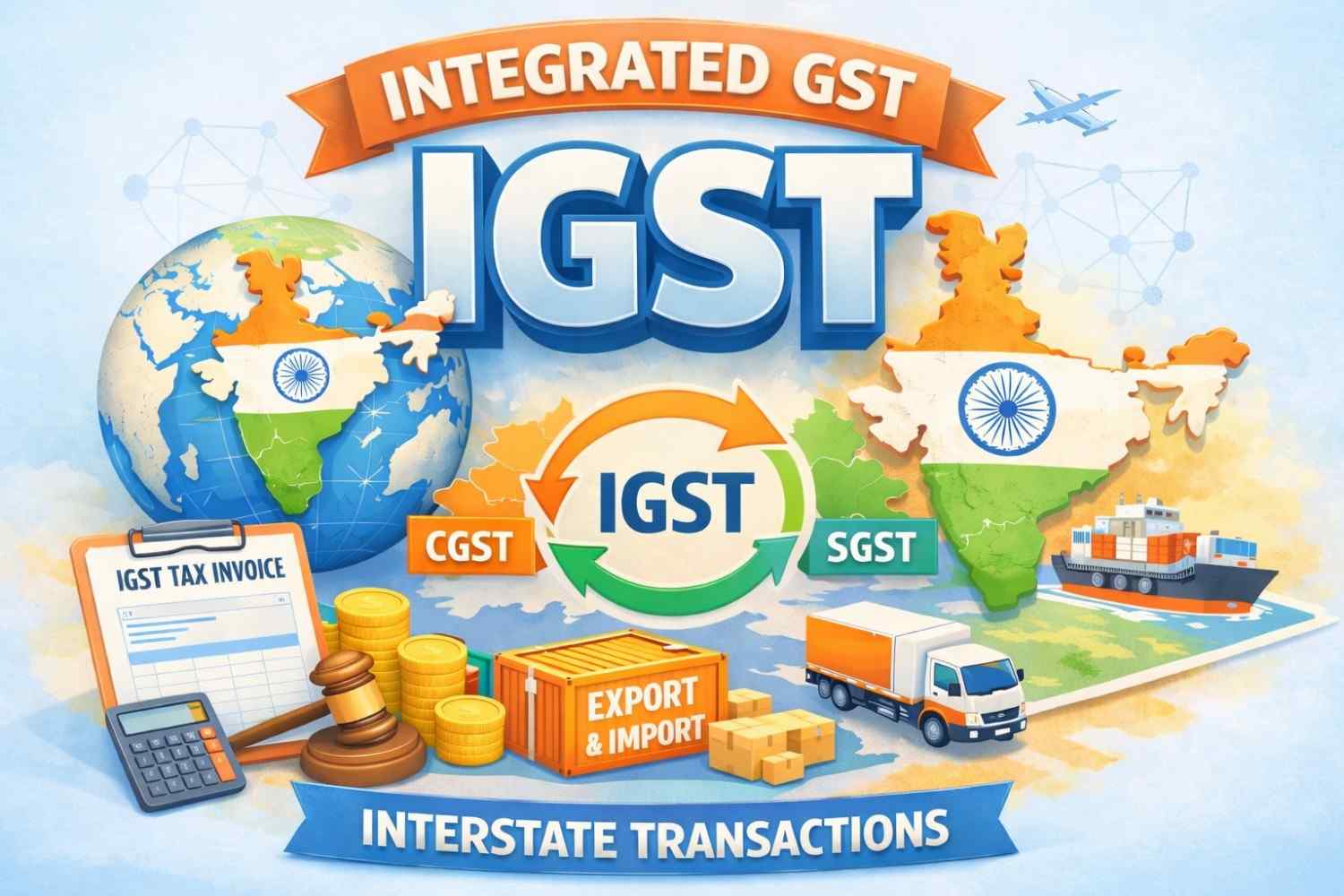

What is IGST? It stands for Integrated Goods and Services Tax. This specific tax is a major pillar of the Indian taxation system. It manages the movement of products as well as services between different states. Simply put, the authorities levy IGST under GST only when a transaction crosses a state border or involves a Union Territory. It keeps the tax flow smooth as items travel across the country.
To truly grasp what is IGST, you first need to look at the broader GST structure. Goods and Services Tax is an indirect tax applied to the production, sale, & use of most goods & services. Since it is a value-added tax, you can claim credits for taxes paid at earlier points in the supply chain. This helps you avoid the “tax on tax” trap.
Here are the main parts of this system –
1. Integrated GST or IGST – The Centre charges this on all interstate trade, imports, as well as exports.
2. Central GST or CGST – This is the portion of GST the Central Government collects on sales within a single state.
3. State GST or SGST – The state government collects this for transactions within its borders.
4. Union Territory GST or UTGST – This works just like SGST but applies to Union Territories.
Calculating what is IGST involves a very straightforward math equation –
IGST = Value of Supply x IGST Rate
This is how you determine the Integrated tax amount for your business transactions –
IGST = Value of Supply x IGST Rate
In this calculation –
1. Value of Supply – This is the actual worth of the items or services you have sold.
2. IGST Rate – The specific IGST rate changes depending on the type of product or service you are dealing with.
Let’s see what is IGST with example scenarios. Let’s say Rohan is a wholesaler in Jaipur. He sells furniture worth Rs 10 lakh to Vikram. Note that Vikram is a retailer in Bengaluru. Vikram later sells those same items to a customer in Chennai for Rs 12 lakh.
Step 1 – Jaipur to Bengaluru
Rohan applies a 12% IGST on Rs 10 lakh. That is Rs 1.2 lakh in tax. Vikram pays a total of Rs 11.2 lakh. Rohan sends this tax to the government. Vikram can use this Rs 1.2 lakh as Input Tax Credit.
Step 2 – Bengaluru to Chennai
Vikram sells the furniture for Rs 12 lakh and charges 12% IGST (which totals Rs 1.44 lakhs). The final buyer pays Rs 13.4 lakhs. Vikram owes the government Rs 1.4 lakhs (approximately). However, he already paid Rs 1.2 lakhs in Step 1. He subtracts that credit- Rs 1.44 lakhs – Rs 1.2 lakhs = Rs 24,000 payable (approx.). This ensures you only pay tax on the value you added (the Rs 2 lakh profit margin).
The main characteristics of IGST include –
1. Applies to interstate movement – You use IGST for any supply between two states, a state and a UT, or two different UTs.
2. Standardised tax rates – Unlike old taxes, this system ensures a uniform IGST percentage for interstate trade across India.
3. ITC benefits – When you buy goods from another state, you are allowed to claim the tax paid as a credit against your future liabilities.
4. Destination-based revenue – The Central Government shares the tax with the state where the goods are actually consumed.
Knowing what is IGST helps you see these business benefits –
1. Simple Tax Logic – It wipes out multiple old interstate taxes (because nobody likes extra paperwork).
2. Easier Trade – You can grow your business across state lines without hitting complex tax walls.
3. Less Tax Fraud – The digital GST network makes it much harder for anyone to dodge their dues.
4. Cheaper Goods – Lower overall tax burdens eventually result in lower prices for your customers.
Because it follows a destination-based logic, the tax is applied where the item is finally used.
Here is the flow –
1. Shipping Across Borders – When you send goods to another state, you add IGST to the bill.
2. Central Collection – The Centre collects the whole amount and then splits it. The state where the goods land gets its share.
3. Credit Offsetting – You only pay the net tax after deducting your available credits. This keeps the money moving.
For example, if a seller in Delhi sends a laptop worth Rs 50,000 to a buyer in Pune with an 18% rate, the IGST is Rs 9,000. The buyer pays Rs 59,000 and the Pune retailer can later use that tax as a credit. This stops the tax from piling up at every stop.
What IGST rules apply to any supply moving outside state boundaries?
It usually falls into four main buckets –
1. Interstate trade – When your goods move from one state or UT to another, you must charge IGST. You collect it and pay it to the Centre.
2. Imports & Exports – Importing goods into India attracts IGST along with customs duty. Exports are “zero-rated” – you can pay the tax and claim it back, or use a bond to avoid paying it upfront.
3. SEZ Transactions – Special Economic Zones are treated as being outside Indian customs territory. Even if an SEZ is in the same state, you must treat the sale as an IGST transaction.
4. EOU Transactions – Export-oriented units also follow these rules. Any supply to or from these units involves IGST.
IGST is applicable if you are a Mumbai seller sending a phone to a local Mumbai buyer, you use CGST and SGST. If that phone goes to Kerala.
What is the IGST amount? It is basically the sum of CGST and SGST.
Here is how the rates usually look –
| Type of Items | IGST Rates |
|---|---|
| Daily essentials and basic education | 5% |
| Processed foods and electronics like mobiles | 12% |
| Mid-range goods like pasta or capital equipment | 18% |
| Premium luxury items and cars | 28% |
Understanding what is IGST requires knowing how it differs from the other two –
| Features | IGST | CGST | SGST |
|---|---|---|---|
| Full Form | Integrated Goods and Services Tax | Central Goods and Services Tax | State Goods and Services Tax |
| Applied to | Interstate and Foreign Trade | Sales within a state | Sales within a state |
| Collected By | Central Government | Central Government | State Government |
| Sharing | Split between Centre and State | Stays with Centre | Stays with State |
| Credit Use | Can offset IGST, CGST, SGST | Can offset IGST, CGST | Can offset IGST, SGST |
| Example | Noida to Gurgaon sale | Sale within Noida | Sale within Noida |
Here are the things to keep in mind related to IGST –
1. Invoicing – You must clearly list the IGST on your bill for any out-of-state sale.
2. Registration – You and your buyer both need a valid GSTIN to make sure the credit flows correctly.
3. Control – The Central Government manages the rules here to keep things uniform.
4. Customs – Remember that imports are always treated as interstate supplies for tax purposes.
Claiming credit for IGST is quite similar to other GST types.
You just need to check these boxes –
1. You must have a formal GST registration.
2. Your invoice must show what is the rate of tax of IGST & the HSN code.
3. You need to accept the supplier’s entry on your GST portal dashboard.
4. You must file your GSTR-3B returns on time.
Sometimes your tax credits are higher than what you owe. This happens often in exports. Since exports have a NIL tax liability, the tax you paid on raw materials stays in your account. In these cases, you can ask for a refund of the IGST amount from the government.
The money is divided if a buyer in Mumbai pays Rs 2000 as IGST. The Central Government takes Rs 1000. The Maharashtra State Government receives the other Rs 1000. It is a 50-50 split between the two authorities.
Now you know what IGST is. It makes sure that moving goods from Punjab to Tamil Nadu is as easy as selling them next door. By managing tax centrally, you keep compliance simple and your business growing. If you need funds to grow that business, checking your personal loan eligibility criteria or reviewing personal loan interest rates might be your next logical move.
What is the full form of IGST? It stands for Integrated Goods and Services Tax. This is a specific tax category under the broader GST umbrella in India. You apply it primarily to the movement of goods and services across different state boundaries or during import and export activities to ensure uniform taxation nationwide.
You apply IGST whenever there is an interstate supply of goods or services. This means the seller and the buyer are located in different states or Union Territories. It also applies to any items you import into India or transactions involving Special Economic Zones & Export Oriented Units.
You need to multiply the total value of the goods or services by the applicable IGST percentage to calculate this tax. You can multiply 10,000 by 0.18 to get a tax amount of Rs 1,800 if you sell an item worth Rs 10,000 and the tax rate is 18%.
There is no single rate for all items. Instead, the IGST rate depends on the nature of the product. Common slabs include 5%, 12%, 18%, and 28%. Essential items usually fall into lower brackets, while luxury goods are taxed at the highest rate. You should check the specific HSN code.
The GST Council determines the rates for various products and services. Generally, the rate of tax of IGST is the combined total of the CGST and SGST rates that would apply to a local sale. If CGST and SGST are both 9%, the IGST will be 18%.
Yes, certain items like alcohol for human consumption and petroleum products stay outside the GST net for now. What is section 7 of IGST Act? It clarifies the specific rules for what counts as an interstate supply. Some goods may have a cess added to the standard rate for luxury items.
If you make any interstate taxable supplies, you generally must register for GST regardless of your annual turnover. Unlike local sales, it has a threshold that, when crossed, usually triggers a mandatory registration requirement. You must have a valid GSTIN to collect tax and pass on credits to your customers.
The seller or service provider collects the tax from the buyer at the time of the transaction. The seller is then responsible for remitting this collected amount to the Central Government. If you are importing goods, you pay the tax directly to the customs authorities at the port of entry.
The Central Government initially collects the revenue. However, because GST is a destination-based tax, the Centre keeps its portion and transfers the remaining share to the state where the goods are consumed. This ensures the “consuming state” benefits from the tax revenue rather than the “producing state” where manufacturing happened.
Yes, you can claim ITC on the IGST you pay for business purchases. This credit can be used to pay off your future IGST, CGST, or SGST liabilities. It is quite flexible. You must ensure your supplier uploads the invoice correctly so it appears in your digital tax ledger.
You can use IGST credits to pay off your IGST liability first. If any credit remains, you can apply it toward your CGST and then your SGST debts. This order is strictly defined by the tax department to ensure the credit flow remains transparent and balanced between the central and state accounts.
Rule 96 specifically covers the refund of IGST paid on goods exported out of India. When you export goods and pay the tax upfront, the shipping bill you file is treated as a refund application. Once the customs department confirms the goods have left, the government automatically processes your tax refund.
Section 19 deals with situations where you accidentally pay IGST instead of CGST and SGST (or vice versa). If you mistakenly treat an intrastate sale as interstate, you must pay the correct tax first. Then, you can claim a refund for the wrongly paid tax under this specific section.
You can track your refund status by logging into the official GST portal. Navigate to the “Services” tab, select “Refunds,” and then click on “Track Application Status.” You will need your ARN (Application Reference Number) or the relevant financial year details to see exactly where your money is.
You can find the rate by looking up the HSN or Harmonised System of Nomenclature code for goods or SAC or Services Accounting Code for services on the official GST website. Remember to check the personal loan processing fees & personal loan documents required for business needs. This is for cases where you are managing your finances.
Download our personal loan app to apply for a personal loan. Get up to 2Lakhs* as a personal loan. Download Now!


Sign into avail a personal loan up to ₹ 2,50,000

Unifinz Capital India Limited is a Non Banking Finance Company (NBFC) registered with the Reserve Bank of India (RBI). lendingplate is the brand name under which the company conducts its lending operations and specialises in meeting customer’s instant financial needs.















 RBI CMS
 RBI Sachet


