
Did You Know?
We serve loans, the best way you can borrow
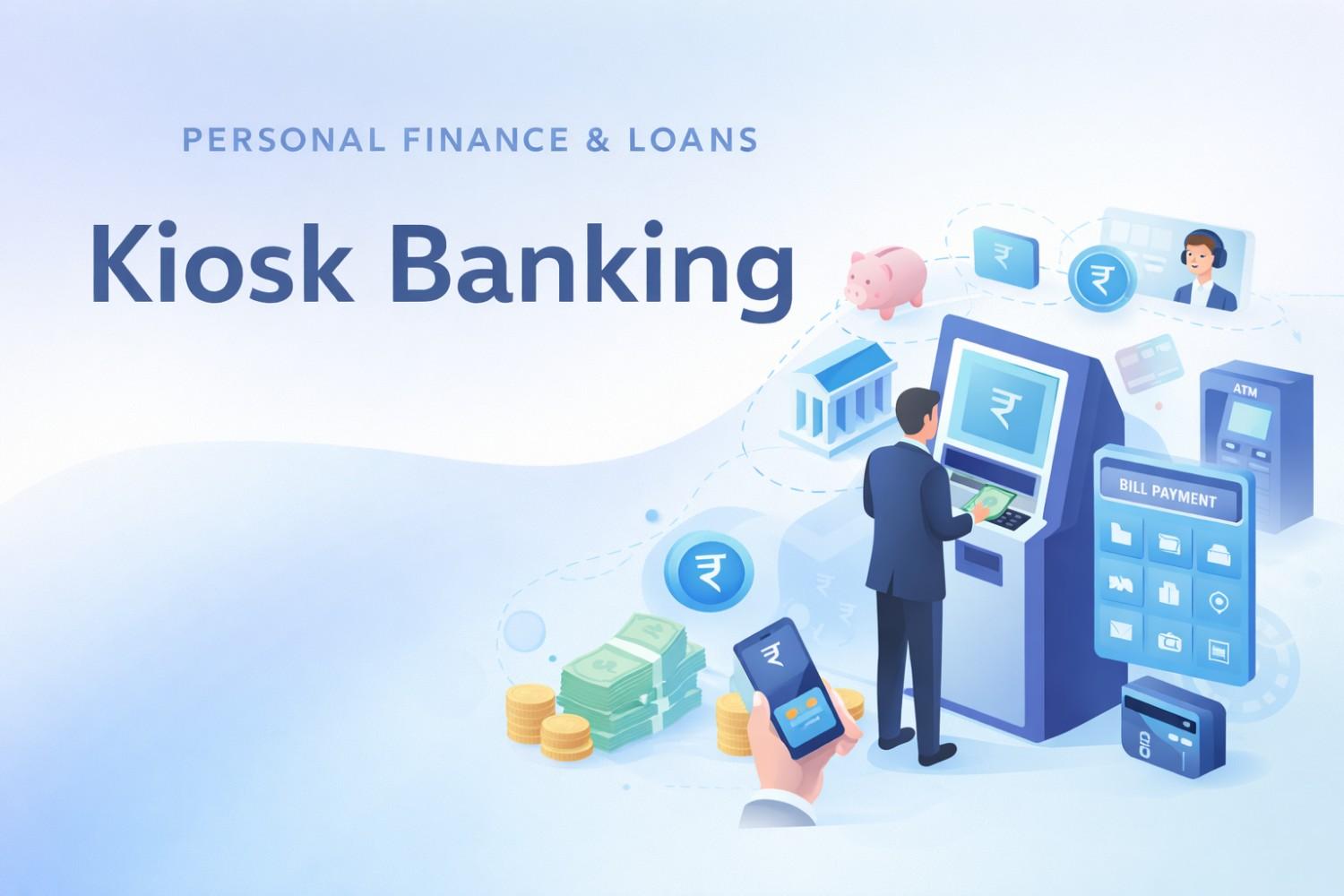

Kiosk banking functions as a specific branchless service model. It lets you manage your money at a digital terminal or a specialised booth, rather than visiting a main office.
A kiosk is just a compact stand designed to provide specific data or assistance.
This setup offers several perks over old-school bank visits. You get more freedom since you can finish tasks quickly and on your own terms. It also stops you from wasting time in long branch queues. For the banks, it keeps costs low because they don’t have to hire a full team for every location.
However, some downsides exist. You may find the digital interface a bit complex at first if you are not that tech-savvy. Also, these booths are usually located in busy public areas. This makes them more prone to accidental damage or even theft.
The main goal of launching kiosk banking was to ensure you have access to financial tools regardless of where you live. Opening a branch in every tiny village is basically impossible in a country as large as India. It costs too much and takes too long. So, kiosk banking became the bridge to fix this problem. It focuses on helping people in rural areas get the same opportunities as those in big cities.
The Kiosk full form in banking comes from “Kommunikasjon Integrert Offentlig Service Kontor“. It is a Norwegian term that basically describes a small hut with an open front.
Usually, these are set up inside local stores or retail shops in your neighbourhood. This makes banking much easier to reach. To fully grasp what kiosk banking is, you should look at its two main parts.
There are two primary parts to this setup –
1. Customer Service Point (CSP) – These desks help you get answers to your questions without any delay. The whole point of a CSP is to make your experience better so you keep coming back to the bank.
2. Kiosk Machine – These are the actual devices that let you handle basic tasks on your own. They make you more independent and speed up the whole process.
3. Customer Service Point – This is basically a dedicated desk in a shop. It connects you directly to a private or government bank. You can talk to the staff here if you have trouble with a transaction or your account.
4. Kiosk Machine – It lets you deposit cheques or check your balance. It usually has a barcode scanner, a cash slot, a printer for receipts, and a touch screen. It even has a camera and speakers to help you through the steps.
Kiosk banking is not only about being close to your home; it offers specific tools to make your life easier –
1. Simple Interface – The screens use very basic layouts so you won’t get confused.
2. Safe Transactions – Security is the top priority here. These machines use heavy encryption to keep your money safe.
3. Fast Results – Because these machines handle specific tasks, you won’t be waiting around for hours.
4. Local Languages – Most kiosks speak your language. You can choose regional dialects to understand everything clearly.
5. Low Costs – The fees for using these services are usually tiny. This makes it very affordable for everyone.
The main perks of using these self-service systems include –
1. The machines are very intuitive. They guide you through every step so you don’t feel lost.
2. Digital banking reduces the stress of paperwork. It makes everything faster and more comfortable while still giving you a physical place to go.
3. You get a one-stop shop for many tasks. You can deposit cash, withdraw money, or even start a new account right there.
Kiosk banking gives you a simple way to reach your bank without needing a massive building. Here are other benefits –
1. Close to Home – These small machines fit in places where a big bank cannot go. You will likely find one just down the street.
2. Zero Waiting – These terminals handle the routine stuff. This moves people away from the main branch and cuts down your wait time.
3. Always Open – If the kiosk is outside, it doesn’t sleep. You can use it 24/7 at a time that actually fits your schedule.
Most of these setups are in rural zones. Even though the rules to apply for kiosk banking are simple, some hurdles remain. Here are the common issues-
1. Infrastructural Restrictions – As we noted, rural areas sometimes lack what’s needed. Frequent power cuts or weak internet signals can stop you from finishing your transaction.
2. Low Public Awareness – Not everyone knows how these booths work yet. This makes it hard for banks to get more people to use them regularly.
3. Fraud Anxiety – You might worry about losing your money to scams. Some people have had bad luck in the past or just don’t yet trust machines. This keeps people away.
4. Safety Hurdles – Protecting the physical machine is tough. Vandalism or digital hacking attempts are real threats that banks must constantly monitor.
5. Technology & Maintenance Costs – Technology still costs money even when it’s cheaper than a branch. Suppose people do not use the kiosk enough. Then, the bank might find it too expensive to keep running.
This is a fresh way to bring money management to your doorstep. Even if they don’t offer every single thing a big branch does, they cover the essentials you actually need.
Here is a breakdown of what you can do –
1. Basic savings account – You can start a simple account even if you’ve never had a bank record before. (This really helps with financial inclusion).
2. KYC process – You can finish your identity checks at the kiosk with very little paperwork.
3. Cash deposits – You can put money into your account instantly.
4. Cash withdrawals – You can take out your cash whenever you need it.
5. Interbank transfer – Send money to a different bank using IMPS.
6. Intrabank transfer – Move money between accounts in the same bank without any hassle.
7. Utility bill payment – You can pay for your light, water, or gas here.
8. Recharges – It is easy to top up your phone credit.
9. Microloans – These are great for small business owners in villages who need a bit of help.
10. Loan repayment – You don’t have to travel far to pay back your debt; just do it at the booth.
11. Account balance check – See how much you have in seconds – how to check balance in Kiosk banking is usually the first option on the screen.
12. Transaction history – Print a small slip showing your recent spending.
13. Insurance enrolment and premium payment – You can sign up for insurance and pay your monthly fees.
14. Government Information and Enrolment – The kiosk helps you sign up for government aid programs.
15. ATM Cash withdrawal – Better machines act just like an ATM.
16. Inquiries – Talk to the person at the desk for help.
17. Problem resolution – If something goes wrong, you have a place to complain and get it fixed.
Using a kiosk is quite straightforward. You pick what you need from the menu. Then, you type in your details like your account or phone number. If you are taking money out, you enter the amount. The system checks your info and then gives you the cash or a receipt. It is that simple.
Kiosks pop up in other places too –
1. Ordering a burger at a fast-food joint
2. Finding your way in a mall
3. Returning a library book
4. Buying cinema tickets
5. Updating your ID or license
These systems actually came around after ATMs were already popular. There are some big differences in how they serve you.
| Feature | Kiosk Banking | ATM |
|---|---|---|
| Account Requests | You can easily ask for a new chequebook. | Usually not an option. |
| Support | You get a direct link to a help desk or a real person (CSP). | You are mostly on your own if the machine eats your card. |
| Reporting | The bank gets detailed reports to improve its service. | They mostly just track cash levels. |
| Cheque Deposits | You can drop off cheques for processing. | Most basic ATMs don’t allow this. |
| Internet Banking | You can log in to your web portal to move funds. | This is strictly for card-based tasks. |
| Assistance | A dedicated agent is often nearby to guide you. | No one is there to help if you get confused. |
Banks usually partner with local shops to set these up. But can you do it? The rules change depending on the bank, but here is what they usually look for-
1. You must have a proper ID & a permanent address. Usually, you need to have finished at least the 10th grade.
2. Your background must be clean. No legal trouble or criminal record.
3. You might need a small amount of cash to buy the equipment and set things up.
4. You have to know how to use a computer and the web (nothing too fancy, just the basics).
If you want to know how to apply for kiosk banking for your own shop, you need to hand over some paperwork. They will usually ask for-
1. The Official Bank Application Form (Fully Completed)
2. Identity Proof – Your Aadhaar, Voter card, or your License
3. Address Proof – An electricity bill for the shop where you want the kiosk
5. Ration Card – This helps verify your household details
6. Photos – Usually two recent passport-sized ones
Once you have these ready, you can start looking into personal loan interest rates if you need extra funding for your setup.
Kiosk banking is expanding the banking sector. By bringing financial services to the most remote corners, it ensures nobody feels ignored by the financial world. As we get more digital, these booths will be the main reason everyone stays connected. If you need more specific help or want an instant personal loan, lendingplate offers plenty of options to help you grow. Your financial future is just a quick visit away.
You can perform various tasks, such as opening a savings account or checking your balance. It allows you to deposit and withdraw cash without visiting a branch. You can also pay utility bills & recharge your phone. Besides, you can transfer money via IMPS. A few kiosks even help you apply for small loans or enrol in government social security schemes and insurance plans.
You generally need to be at least 18 years old to open an account through this facility. However, some banks allow minors to have accounts if a guardian supervises them. If you want to become an agent and run a booth, you must be an adult with a valid identity proof and basic educational qualifications to manage the system.
The limits are usually lower than those of regular branch banking to maintain security. Often, you can withdraw or deposit up to ₹10,000 or ₹20,000 per day. These boundaries exist because the kiosks operate in a branchless environment. If you wish to move a larger amount, you may have to visit a full-fledged bank branch or use official mobile banking apps.
Most accounts opened at these kiosks are “No-Frills” or BSBD accounts. Usually, the maximum balance you can hold at any given time is capped at ₹50,000. The bank might ask you to convert it into a regular savings account if your balance exceeds this limit. This ensures the service remains focused on small-scale savings for everyday people.
Yes, it definitely does. All kiosk banking operations must follow the strict guidelines set by the Reserve Bank of India. The RBI monitors these services to protect you from fraud and ensure banks are actually helping the rural population. They must adhere to the same legal and safety standards as any branch since these are extensions of regular banks.
Most basic services (like checking your balance or depositing cash) are free or have very small fees. The goal is to keep it affordable for everyone. Nonetheless, some banks may charge a small fee for certain tasks, such as transferring money to another bank. Always ask the agent at the booth for a list of any service charges before you begin.
Download our personal loan app to apply for a personal loan. Get up to 2Lakhs* as a personal loan. Download Now!


Sign into avail a personal loan up to ₹ 2,50,000

Unifinz Capital India Limited is a Non Banking Finance Company (NBFC) registered with the Reserve Bank of India (RBI). lendingplate is the brand name under which the company conducts its lending operations and specialises in meeting customer’s instant financial needs.










 RBI CMS
 RBI Sachet


