
Did You Know?
We serve loans, the best way you can borrow
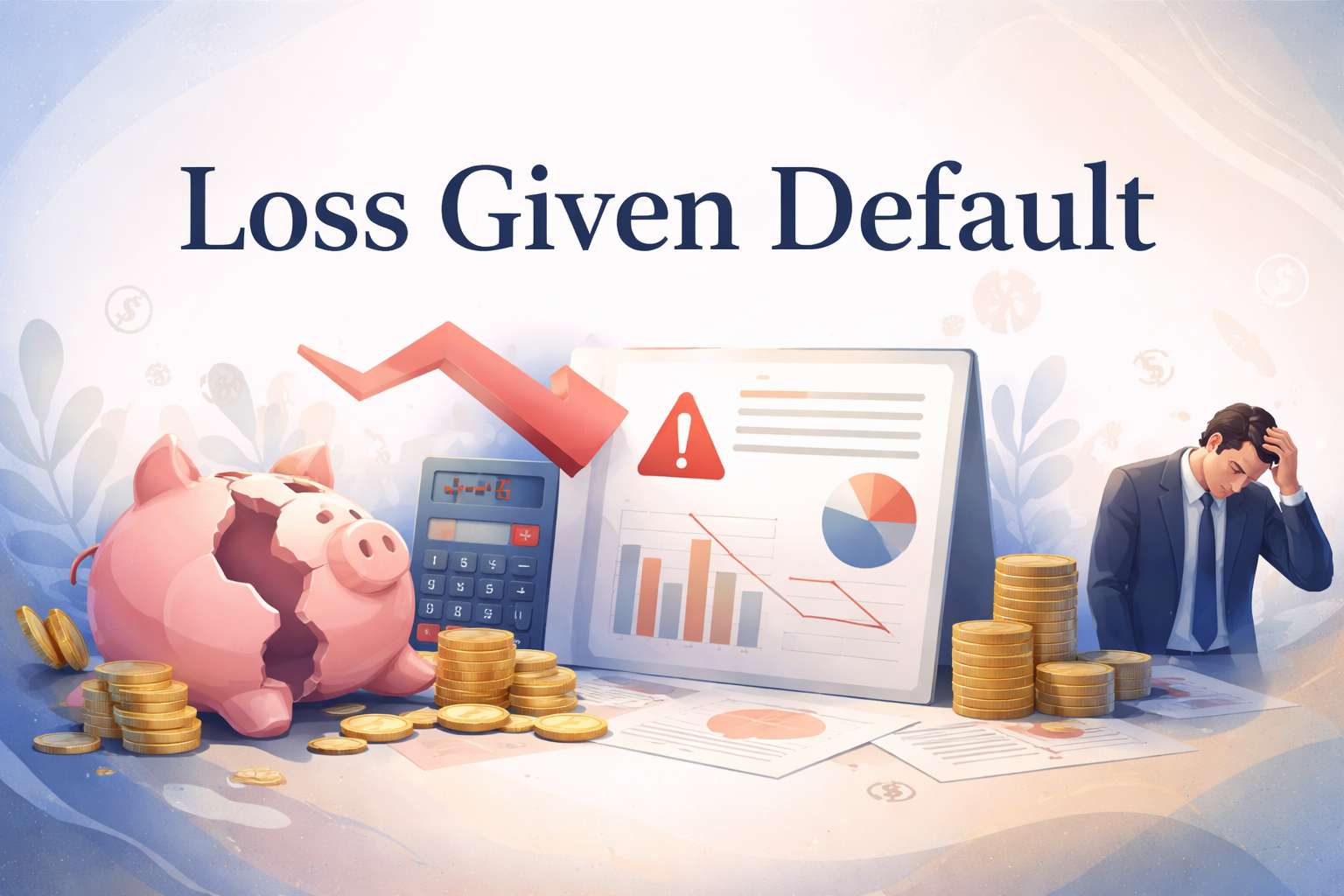

Loss given default is the amount of capital a bank or lending institution expects to lose when a debtor fails to meet the repayment obligations.
You may view loss given default as a percentage of the total amount owed at the time of the breach, or as a fixed numerical value. This represents the predicted financial impact.
Note that lenders determine their loss given default by reviewing each active loan and assessing historical total-loss patterns relative to their current lending volume.
You can determine the loss given default formula by following these three distinct stages:
Step 1: You first need to evaluate the expected recovery rate for any claims you hold as a lender.
Step 2: Next, you must identify the Exposure At Default (EAD), which represents the total capital you have provided.
Step 3: Finally, multiply that EAD figure by 1 minus your recovery rate.
The formal loss given default formula is –
Loss Given Default (LGD) = Exposure at Default * (1 – Recovery Rate)
You might find far more intricate mathematical models for credit risk elsewhere. However, this straightforward method remains the standard for basic estimation.
You have various paths to choose from when you want to learn how to calculate loss given default.
One common method assesses exposure at default alongside the recovery rate. This exposure is an estimate of the hit a bank or lender takes when you (or any debtor) stop paying. The recovery rate serves as a safety-adjusted metric to scale the loss based on how likely you are to recover funds.
Loss Given Default (in cash) = Exposure At Default (EAD) x (1 – Recovery Rate)
A second simple choice weighs your likely net cash proceeds against the total debt still owed. This specific ratio shows you exactly what part of the debt you should expect to lose.
Loss Given Default (as a percentage) = 1 – (Potential Sale Proceeds / Outstanding Debt)
Lenders usually prefer the first method because it provides a conservative estimate of the maximum possible loss. Actually, figuring out sale proceeds is tricky because of things like asset liquidity and legal costs.
Suppose you take out a Rs 400,000 loan to buy a property. You pay your installments for several years, but then hit a financial rough patch.
Your lender calculates an 80% chance you will default, meaning the recovery rate stays at 20%. Your remaining debt is Rs 300,000 and the bank believes it can sell your flat for Rs 200,000 after taking it back.
To find the loss given default example in cash terms, the lender looks at the risk vs the default odds. Using that first method, they see Rs 240,000 is vulnerable.
Loss given default (ignoring the property) = Rs 300,000 x (1 – 0.20) = Rs 240,000
You can also find this as a percentage that includes the property value. The first way is quicker, but it ignores what the bank gets from selling your home. So, using that second method (which factors in collateral), the lender expects to lose about 33% of their money.
Loss given default (including the property) = 1 – (Rs 200,000 / Rs 300,000) = 33.33%
When you provide a loan to a borrower, you have three primary ways to get your money back. (We’ll look at a business borrower for this part). These are your options in order:
1. Standard Repayment – This happens if the borrower pays all principal and interest on time until the end. Or, they might move the debt to another bank and pay you off early.
2. If they default and cannot pay you back or move the debt, you then look to – Sell the borrower’s assets to recover as much of the outstanding debt as possible.
3. If selling those assets doesn’t cover your total exposure, you have “residual” debt. You try to fix this via – Alternative “recourse” – This is usually a personal or company guarantee from the owners. This only works if you agreed on this backup plan at the start.
You calculate the loss given default by subtracting the asset’s expected recovery rate from 1.
This recovery rate is just a percentage showing how much of the value you can realistically recover if a client stops paying and you have to sell off assets.
If you expect a 75% recovery rate (0.75), then your loss given default is (1 – 0.75).
That equals 25%.
A higher recovery rate always means you face a much lower loss given default.
Unlike liquidity ratios like the quick or current ratio, loss given default does not tell you if a borrower is likely to stop paying. It focuses solely on measuring the damage to you, as a lender, if they do stop. (LGD on its own doesn’t show the probability of the event happening).
You have to look at loss given default with other credit tools to see the real danger to your capital.
Understanding loss given default is vital for any modern lender managing a portfolio. It gives you a clear picture of the potential financial damage you face when a borrower stops paying. While it doesn’t predict the likelihood of a default, it helps you prepare for the worst-case scenario.
Using the loss given default formula helps you balance your risk with better interest rates. Always remember to consider LGD alongside other metrics to keep your lending business healthy and secure in the long term.
Check out lendingplate’s Long Term Loan
Loss given default is a vital metric that tells you the exact amount of money a lender stands to lose if you fail to repay your debt. It measures the loss as a percentage of your total loan exposure at that specific moment. Lenders use this to prepare for financial hits and to set aside enough capital. It focuses on the severity of the loss rather than the chance of it happening.
These two metrics work together to show you the total risk of a loan. While PD tells you how likely it is that you will stop paying, loss given default tells you how much money the lender loses if you actually do. You multiply them together (along with exposure) to find the expected loss. One measures the “if” and the other measures the “how much” regarding your credit risk.
Yes, you can have a zero loss given default in specific situations. This usually happens if your loan is fully backed by high-quality collateral that the lender can sell very easily. If the value of your property or cash deposit covers the entire debt and the costs of selling it, the lender loses nothing. In these cases, the recovery rate is 100%, making the final loss calculation exactly zero.
Several things change your loss given default. The main factor is the type and value of collateral you provide for the loan. If you have a secured loan, the LGD is usually lower. Other factors include the current economic climate, the legal costs of recovering money, and the specific industry of the borrower. Even the time it takes to sell an asset will impact the final loss the lender records.
While it is rare, loss given default can actually go over 100%. This happens when the costs to recover the money exceed the loan amount. For example, if a lender spends a fortune on legal fees and property maintenance but the asset value crashes, they lose more than the original debt. You usually see this in complex commercial cases or during severe economic downturns where assets become quite illiquid.
You see a zero LGD when your loan is perfectly collateralised. Suppose you provide a cash margin or government bonds that cover the debt. Then, the lender is safe. Since these assets don’t lose value and are easy to trade, the recovery is total. Another condition is if a third party with a perfect credit rating guarantees your loan. In these scenarios, the lender expects to recover every single penny.
When you take an instant personal loan, the lender looks at whether it is secured or unsecured. For an unsecured instant personal loan, they estimate LGD based on historical data from similar borrowers. They look at how much they usually recover through debt collection agencies or court orders. They subtract this expected recovery from your total balance. Since you have no backup house or car, the LGD is usually quite high.
LGD is higher because you haven’t pledged any assets, such as a car or a house, to the lender. If you stop paying, the lender has nothing to seize and sell quickly to recover their money. They have to rely on legal action or nudging you to pay, which is expensive and slow. Because the recovery rate is so low for these loans, the loss given default naturally stays very high.
Actually, your credit score mainly impacts the Probability of Default rather than the loss given default. However, a better score might suggest you have more assets or a stable income that a lender could target during recovery. If you have a high score, a lender might assume they can recover more through standard legal channels. Mostly, LGD depends on the loan structure and collateral rather than just your personal credit history.
The length of your loan can change the loss given default because long-term assets are harder to predict. Over the next 10 years, the value of your collateral might drop, or the economy might change. A longer tenure increases the uncertainty of the recovery rate. Lenders often find it harder to estimate LGD for long-term debt than for short-term debt. This is because market conditions for selling your assets can fluctuate wildly over many years.
Download our personal loan app to apply for a personal loan. Get up to 2Lakhs* as a personal loan. Download Now!


Sign into avail a personal loan up to ₹ 2,50,000

Unifinz Capital India Limited is a Non Banking Finance Company (NBFC) registered with the Reserve Bank of India (RBI). lendingplate is the brand name under which the company conducts its lending operations and specialises in meeting customer’s instant financial needs.


















 RBI CMS
 RBI Sachet


