
Did You Know?
We serve loans, the best way you can borrow
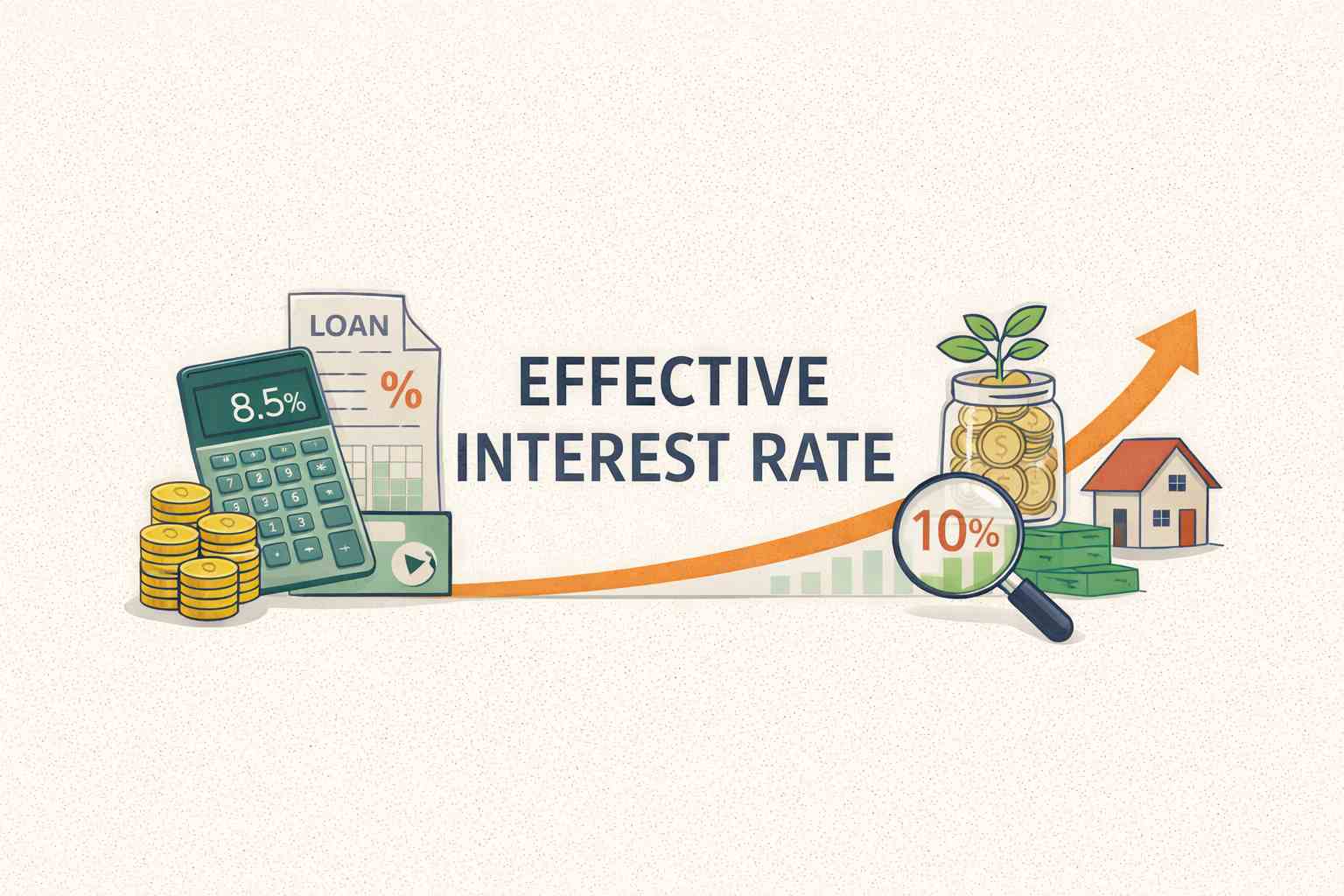

The effective interest rate is the true reflection of the yearly interest you pay on a loan (specifically accounting for how often interest is added to your balance). A standard nominal rate offers you a baseline. However, this figure offers a more precise calculation of your actual borrowing costs because it includes the impact of compounding.
You may use the effective interest rate formula to turn basic nominal rates into a clear metric that lets you compare different financial products (even when they have varying compounding schedules).
The specific formula to calculate effective interest rate is –
Effective Interest Rate = $ [ 1 + ( i \ div n ) ] ^ n – 1 $
Where,
i represents your Nominal Interest Rate
n represents the count of compounding periods in one year
Imagine you need to compare four different loans. Each one has a 6.0% nominal rate, but the frequency of interest addition varies. This effective interest rate example shows how the actual cost shifts from Loan A to Loan D as compounding happens more often.
Loan A – Annual compounding (1x)
Nominal Rate- 6.0%
Calculation- $[1 + (0.06 \div 1)]^1 – 1 = 6.00\%$
Loan B – Semi-Annual compounding (2x)
Nominal Rate- 6.0%
Calculation- $[1 + (0.06 \div 2)]^2 – 1 = 6.09\%$
Loan C – Quarterly compounding (4x)
Nominal Rate- 6.0%
Calculation- $[1 + (0.06 \div 4)]^4 – 1 = 6.14\%$
Loan D – Monthly compounding (12x)
Nominal Rate- 6.0%
Calculation- $[1 + (0.06 \div 12)]^{12} – 1 = 6.17\%$
The gap between these rates grows as interest hits your account more frequently. While these small percentages might look minor at first glance, they drastically change your total debt burden over a long period (especially on larger loan amounts).
Using this metric is vital because it reveals the genuine cost of your debt or the actual profit from an investment.
Because of compounding, your stated rate and your real rate often look very different. Checking the EAR helps you pick the right loan or find the investment that actually pays out the most. When interest compounds, the effective rate always climbs higher than the basic annual rate.
This rate illustrates the real-world interest attached to your loan or savings. It works by acknowledging that more frequent compounding periods naturally push your total interest higher.
It’s basically interest on top of interest. If you look at two 10% loans where one compounds once a year and the other twice, the latter will always cost you more in the end.
Often called the effective annual rate or the annual equivalent rate, this figure shows the actual interest you pay annually by factoring in compound growth. It allows you to make an “apples-to-apples” comparison between different debts. This is much more accurate than a nominal interest rate for making smart money moves. You really cannot ignore compound interest (that “interest on interest” effect) if you are borrowing for a long time.
To find your rate, you just need the stated interest rate and the number of compounding periods. Follow these steps –
If everything else stays the same, more compounding always leads to a higher effective interest rate. Common cycles include-
As frequency goes up, your cost goes up too. You should always use this as your primary comparison tool when you are checking the personal loan interest rates offered by different lenders.
We use these calculations across several parts of your financial life –
While helpful, this metric has flaws. It assumes your interest rate stays exactly the same forever (which rarely happens in the real world).
It also ignores personal loan processing fees, service charges, or maintenance costs. Taxes aren’t included either.
Your actual take-home return might be 20% lower depending on your tax bracket. It also doesn’t measure the risk of an investment, and it isn’t very useful for very short-term money moves where compounding doesn’t have time to act.
These terms sound identical but they aren’t. Your annual interest rate (the nominal rate) is just the flat number the bank tells you. It ignores compounding entirely.
Your effective interest rate does the opposite. It includes compounding to give you a transparent look at what you are actually being charged.
Since many rates compound more than once a year, the two numbers will rarely match.
The difference between nominal interest rate and effective interest rate is all about how we measure cost. The nominal rate is the “sticker price” before we look at compounding.
It can be a bit misleading because it doesn’t show the real cost of debt. The effective rate fixes this by showing the total annual cost including all compounding periods.
Unless interest is only added once a year, the effective rate is always higher. Lenders often prefer showing you the lower nominal rate to make an offer look better. For you as a borrower, focusing only on the nominal rate is a mistake that could cost you quite a bit.
The stated rate (another name for the nominal rate) tells you the bond or loan percentage, but it doesn’t tell the whole story. The effective rate is more accurate because it shows your actual annual return.
Unless compounding happens exactly once a year, the stated rate will always look lower. For example, a 5% bond compounded monthly actually hits 5.116%.
You can’t really compare two different stated rates unless they compound the same way, but you can always compare two effective rates.
The effective method is much more accurate over time but harder to calculate. The straight-line approach just charges the same amount every single period. (It’s simpler but less precise).
You usually see the effective method used when bonds are bought at a big discount or their value changes a lot.
If a bond stays stable, straight-line is usually fine. In the end, both methods result in the same total amount amortised once the bond matures.
Banks usually lead with the stated rate when they charge you money because it makes the loan look cheaper. If a loan is 30% but compound monthly, your real rate is 34.48%. Naturally, they advertise the 30% figure.
However, when they are paying you interest on a savings account, they switch. They will show you the higher 10.47% effective rate instead of the 10% nominal rate to make their account look more profitable. They simply show you whichever number helps them most.
Nominal rates are okay for a basic glance, but you need the EAR for the full truth. Compounding changes everything. If you want to make smart financial choices, you have to look at the real cost of borrowing.
When you are weighing your options for an instant personal loan, checking the EAR ensures you aren’t surprised by the total expense later on. It is the only way to get a truly detailed understanding of your financial health.
The effective interest rate is the actual annual interest you pay or earn on a financial product. It accounts for compounding within the year. While nominal rates give you a base percentage, this figure provides a more accurate view of your real costs or returns by including “interest on interest.”
The main difference is compounding. A nominal rate is just the stated annual percentage provided by your lender. It does not reflect the total cost if interest is added monthly or quarterly. The effective rate includes those extra periods to show the true annual percentage you actually face.
Also Read: Annual Percentage Rate
It is vital because it lets you compare different loans or investments accurately. Without it, you might choose a loan that looks cheap but actually costs more due to frequent compounding. It ensures you understand the total interest burden before you sign any lending agreement or investment contract.
Compounding is the engine that drives this rate higher. When interest is added to your principal more frequently (like monthly instead of annually), you end up paying interest on the previously added interest. This process increases the total amount you owe, pushing the effective rate above the stated nominal rate.
To find this rate, you divide your nominal interest rate by the number of compounding periods in a year. You then add one to that result and raise it to the power of the number of periods. Finally, subtract one from the total to get the decimal version of your rate.
The formula to calculate effective interest rate is $r = [1 + (i / n)]^n – 1$. In this equation, “$i$” stands for your nominal annual interest rate, and “$n$” represents how many times the interest compounds each year. This calculation converts any stated rate into its true annual equivalent.
The more often interest compounds, the higher your effective rate becomes. Daily compounding results in a higher cost than monthly compounding, even if the nominal rate is identical. This frequency determines how quickly your debt grows or how fast your savings accumulate interest, directly impacting your final total.
It is higher as long as compounding happens more than once a year. If your interest only compounds annually, the two rates are exactly the same. However, in almost every modern financial product-like credit cards or personal loans-interest compounds more frequently, making the effective rate the higher of the two.
For loans, this rate shows you the genuine cost of borrowing money. It helps you see beyond the advertised “low” rates that banks use to attract customers. By looking at the EAR, you can calculate your actual monthly burden and avoid being surprised by the total interest paid over time.
In investments, the EAR shows your true annual return. It helps you decide between different savings accounts or bonds. Even if two accounts offer the same nominal rate, the one that compounds more often will give you a better return, which is clearly reflected in its higher effective interest rate.
Download our personal loan app to apply for a personal loan. Get up to 2Lakhs* as a personal loan. Download Now!


Sign into avail a personal loan up to ₹ 2,50,000

Unifinz Capital India Limited is a Non Banking Finance Company (NBFC) registered with the Reserve Bank of India (RBI). lendingplate is the brand name under which the company conducts its lending operations and specialises in meeting customer’s instant financial needs.



















 RBI CMS
 RBI Sachet


