
Did You Know?
We serve loans, the best way you can borrow
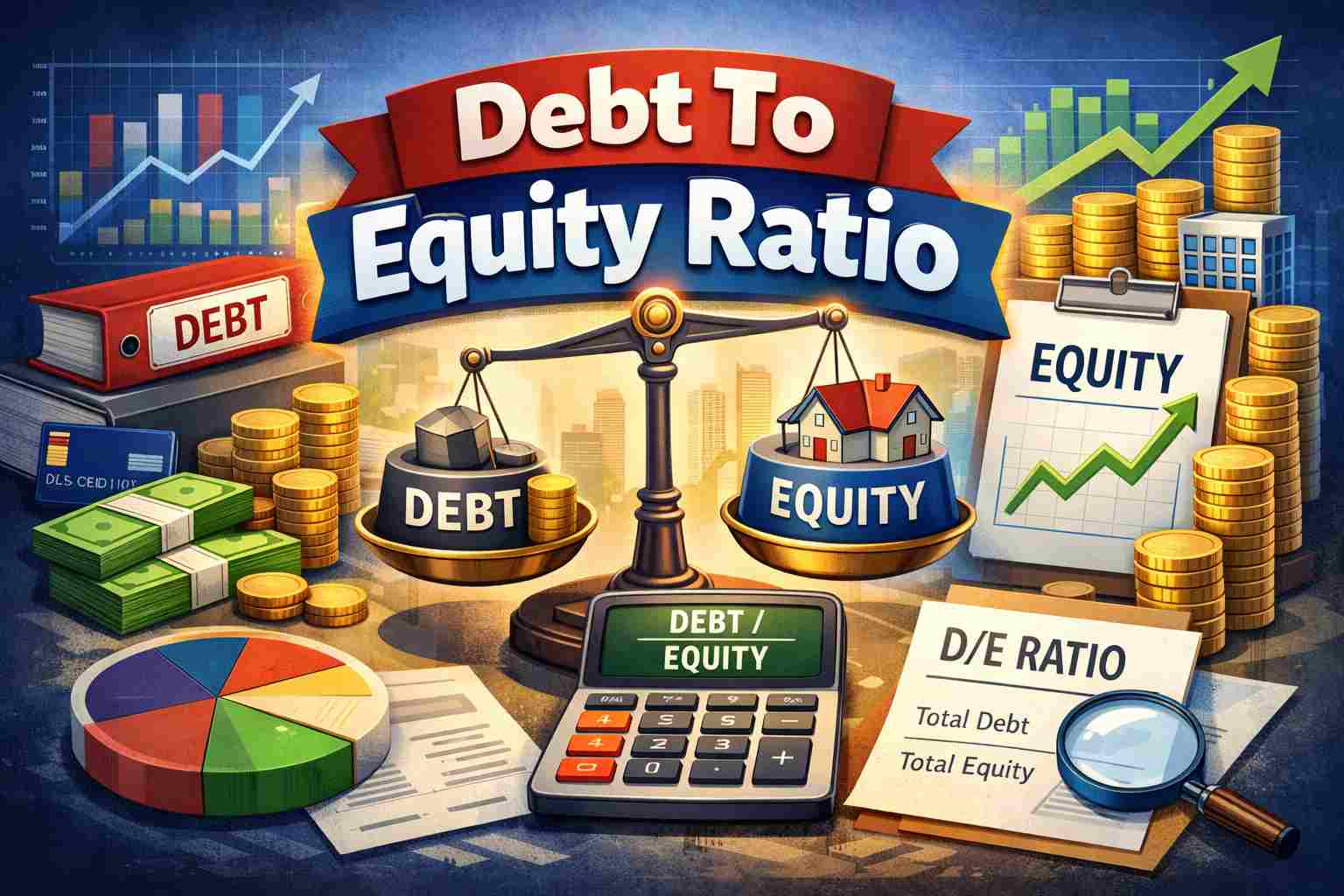

What is the debt to equity ratio? The debt to equity ratio compares the total liabilities of a business against the equity held by the shareholders. Note that this calculation matters as it offers a view of a firm’s capital structure & how it funds its daily operations & future expansion. A lower figure suggests a business is stable. On the other hand, a higher result indicates financial crises you may need to watch out for.
The Debt to Equity Ratio formula is –
Debt to Equity Ratio = Total Debt / Shareholders' EquityTo explain more,
Debt to Equity Ratio = (Short Term Debt + Long Term Debt + Fixed Payment Obligations) / Shareholders’ EquityUnderstand these figures to get a better insight –
You can find the data you need for a debt to equity ratio calculator right on the balance sheet. If you subtract the total liabilities from the total assets, you get the shareholder equity figure.
Sometimes these balance sheet rows include items that aren’t strictly “debt” or “equity” in a traditional bank loan sense. Things like pension adjustments or past losses can skew the result. You might need to dig a bit deeper to see how much the firm really relies on borrowed cash due to this. Most investors or analysts will tweak the debt to equity ratio to get an understanding. They also look at this ratio alongside profitability and the company’s expected growth rate.
Many business owners rely on software to keep track of their financial health metrics. Microsoft Excel, for example, has built-in balance sheet templates that automatically compute your debt to equity ratio.
Your second choice is to type the numbers in yourself. Put your total liabilities in one cell (like B2) and your total shareholders’ equity in the next one (B3).
Then, just enter the formula “=B2/B3” in cell B4
This offers you the ratio instantly. It is a great way to stay on top of your leverage without needing complex accounting tools.
A high ratio isn’t always a bad sign. It can show that a company manages its debt well by maintaining steady cash flow and using that borrowed money to boost returns for owners.
Using more debt actually raises the return on equity in a debt to equity ratio example. The equity portion stays smaller because you are using borrowed funds rather than raising more cash from investors.
This makes the return look much better on paper. Another perk is that debt financing usually costs less than equity financing. You can lower the business’s overall weighted average cost of capital by raising your ratio to a certain level.
The risks appear when that ratio climbs too high. If a company over-leverages, any small loss gets magnified. Eventually, the business might struggle to keep up with interest payments or repay the principal.
Lenders will get nervous when the debt to equity ratio hits a breaking point. Your borrowing costs will jump significantly. Investors will also demand higher returns due to the risk (which will send the WACC soaring). This usually drags the share price down. You become a risky candidate in the eyes of lenders.
The debt to equity ratio interpretation helps you determine a business’s core funding strategy. It tells you whether a company prefers to use its own cash or if it relies on a debt instrument to keep the lights on.
A high ratio is generally viewed negatively by analysts. However, there are some quirks you should know. Remember that different industries have different “normal” levels when you look at the formula again. You must be careful when comparing ratios across different sectors.
How much debt to equity ratio is good? Well, it usually depends on staying under 2.0. If you hit a ratio of 2, it means that for every two pounds of debt, you have only one pound of your own money. That is quite a risky spot to be in.
The longer answer is that “ideal” is relative. While 2.0 is high for some, it might be the standard for mining or heavy manufacturing. In those sectors, a ratio of 2 might be perfectly normal. A 1.0 might be too high for a service business. You really need to check the industry average first. Always compare a company against its direct peers or the industry benchmark to get the real story.
A high debt to equity ratio signals that a company is funded mostly by creditors. This naturally increases the risk of insolvency if business slows. Investors and banks usually hunt for lower numbers because they suggest a safer & more stable environment. You should monitor how this number changes over time. The company might be chasing aggressive growth using borrowed money if it spikes suddenly.
Debt financing is the primary driver behind your debt to equity ratio. Every time you sign for a new loan, your total liabilities go up (which pushes the ratio higher). It shows that your business is relying on outside funding rather than its own internal funds.
Interest costs are a major side effect here. As your debt grows, those monthly interest bills become a permanent fixture in your budget. You have to manage these payments perfectly to avoid trouble.
The risk of a loan default becomes real if you cannot meet these obligations. You have to weigh how much debt you can actually carry before it starts to threaten your company’s future. Always make sure your leverage aligns with what’s normal for your specific field.
Using the debt to equity ratio in your planning can change how you handle growth. If you analyse your position correctly, you can spot big opportunities or early warning signs before they become disasters.
Take the example of a balanced ratio, which makes it much easier to raise capital when you want to expand. This is vital if you are looking to enter new markets or buy property. Using debt to increase your current assets can be a smart move. However, this is only when you watch your cash flow like a hawk. A mix of debt and equity gives you the most room to move.
If your ratio is mostly equity, you might be being too safe. This can actually slow you down and let competitors pass you by. You want a balance that supports your big goals without putting the whole company at risk.
On the other hand, if the ratio stays high, it is a massive red flag. Seeing liabilities grow while assets stay the same is a recipe for a crisis. You should also consider an instant personal loan for very small, urgent needs, but for the business, keep an eye on the total equity. If your debt scares off investors, you will find it much harder to raise cash later.
What is a good debt to equity ratio? A “good” ratio usually falls between 1 and 1.5, but this varies by industry. A ratio of 2 or higher might be standard for capital-heavy sectors like manufacturing. However, most analysts prefer seeing a ratio below 1 since it indicates the company owns more than it owes. This ensures better financial stability.
This ratio indicates the proportion of a company’s funding that comes from creditors versus what comes from its shareholders. It reveals how leveraged a business is and measures its ability to cover all outstanding debts. It tells you the level of financial risk and the health of the capital structure.
You can explain it as a snapshot of how a company pays for its operations. If the ratio is high, the business uses more borrowed money (debt). The business uses more of its own money (equity) if it is low. It shows the balance between risk and ownership within the firm.
You can divide a company’s total liabilities by its total shareholder equity to find this figure. You can find both of these numbers on the company’s balance sheet. It is a straightforward way to see if a business is leaning too heavily on lenders to fund its day-to-day growth.
This shows the company is using more debt than its own capital. However, it is often considered acceptable in many industries. It suggests moderate leverage but requires consistent cash flow to manage interest.
Yes, a ratio of 0.5 is generally considered very good and conservative. It means the company has twice as much equity as it has debt. This suggests that the business is reliant on borrowed funds. That makes it a lower risk option for investors.
A ratio of 0.75 is quite healthy and indicates a strong financial position. It shows that the company’s assets are primarily funded by its shareholders rather than through loans. This level of leverage is usually viewed positively by lenders, as it demonstrates the business can comfortably handle its existing financial obligations.
A zero ratio means a company has no debt at all. While this is extremely safe, it might not always be beneficial. Some debt can help a company grow faster than using equity alone. It could suggest the business is missing out on growth opportunities that debt financing could easily fund.
If you mean a ratio where debt is 90% of the capital structure, then yes, that is extremely high and risky. It implies that almost the entire business is funded by creditors. This leaves very little room for error, as even a small dip in revenue could lead to a default.
A negative debt to equity ratio occurs when a company has more liabilities than assets, resulting in negative shareholder equity. This is usually a major warning sign of potential bankruptcy or severe financial distress. It often happens after a company has experienced years of significant losses that wiped out its capital.
Industries that require expensive equipment or infrastructure have higher ratios. That may include sectors such as manufacturing or telecommunications (also utilities as well as mining). These businesses often take on large loans to purchase machinery or build networks. They pay off over many years using the revenue those assets generate.
It measures risk by showing how much the company relies on external lenders. Note that a high ratio means high interest payments. This can drain cash flow. Suppose the business hits a rough patch. Then, the fixed costs become a burden. A lower ratio suggests the company can weather financial storms much more easily.
Download our personal loan app to apply for a personal loan. Get up to 2Lakhs* as a personal loan. Download Now!


Sign into avail a personal loan up to ₹ 2,50,000

Unifinz Capital India Limited is a Non Banking Finance Company (NBFC) registered with the Reserve Bank of India (RBI). lendingplate is the brand name under which the company conducts its lending operations and specialises in meeting customer’s instant financial needs.


















 RBI CMS
 RBI Sachet


