
Did You Know?
We serve loans, the best way you can borrow
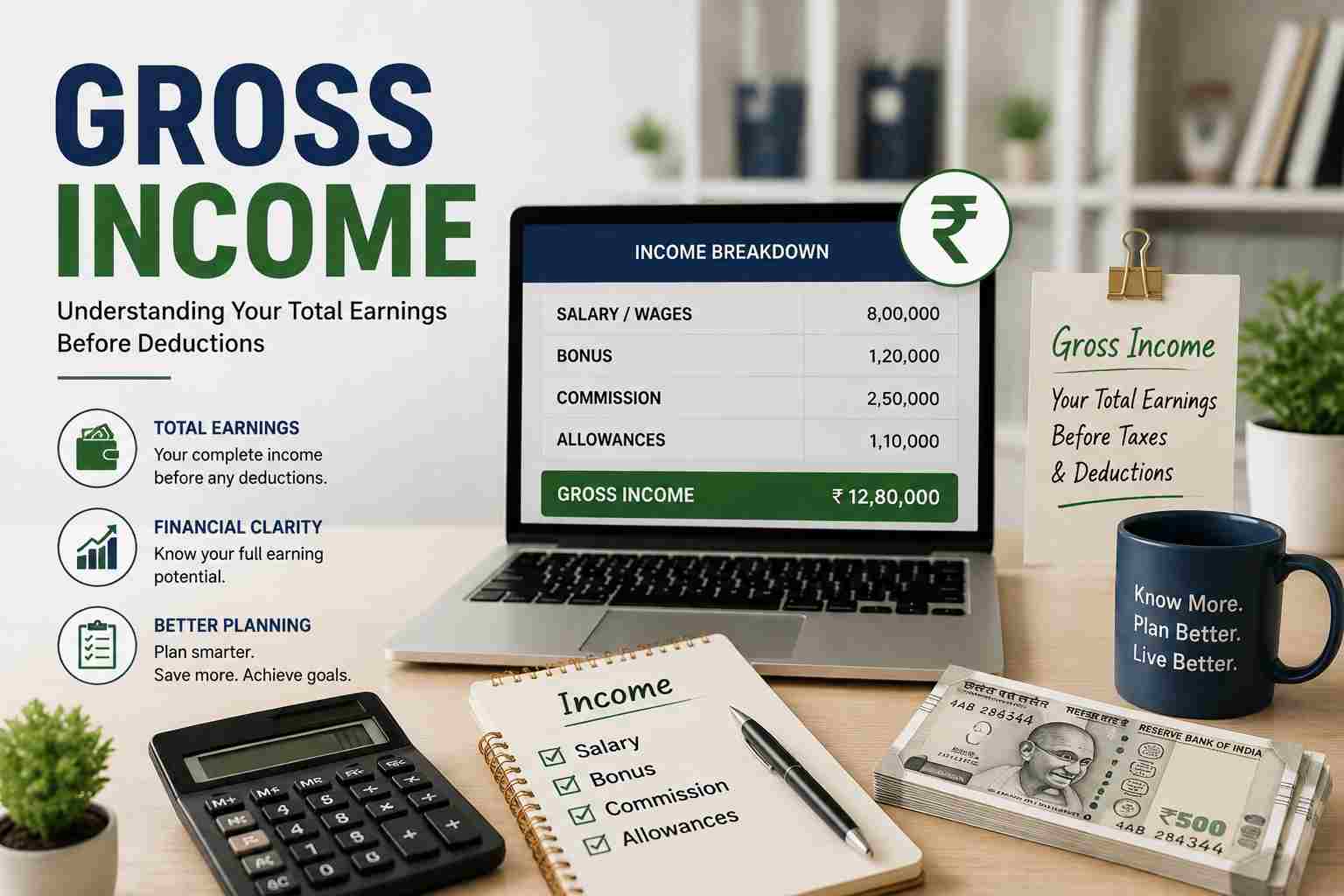

Opting for a personal loan lets lenders look at various factors before approving your request. One of the most important is your gross income. This figure tells lenders how much you earn before deductions and helps them decide if you qualify. It also affects how much you can borrow and the personal loan interest rate you may get.
In this blog, you will learn what is gross income and how it differs from net income. Most importantly, you will also understand its key role in personal loans.
Going by the gross income definition, it is the total money you earn before anything gets deducted (for instance, tax or provident fund or some other charges). Gross income for a salaried employee includes the basic pay, bonuses as well as allowances (or anything they receive as income). On the other hand, gross income for the self-employed refers to the profit you make from your business or profession before subtracting expenses.
Knowing how to calculate gross income matters because lenders use it to check your financial strength and repayment capacity. It helps them decide the loan amount they can manage to repay with ease.
Gross income shows your total earnings before deductions such as tax or other charges. It covers the salary, business profit, extra income, and allowances.
On the other hand, net income is the amount left after the deductions. If you consider a company, the net income is the revenue excluding expenses such as ad costs, interests, taxes and deductions (legal or professional fees).
If the net income is a positive value, it is a profit. However, it shows that the business incurred a loss if it is negative.
Suppose the difference between gross income vs net income is significantly high. Then, it indicates that the business incurs multiple expenses. In such a scenario, the business should review its expenses to remove unnecessary expenses and, at the same time, reduce necessary expenses.
Also Read: FOIR
The following are the ways in which gross income may impact personal loan terms as well as eligibility:
Lenders consider the gross income when assessing your personal loan eligibility. When the gross income is higher, it automatically increases the chances of approving the loan. It reassures lenders about your repayment abilities.
The gross income may impact the total loan amount you qualify for. Your lender will calculate the amount of the loan depending on the gross income percentage. A high income allows for a larger amount.
Your gross income impacts the personal loan processing fees as well as the interest that lenders offer. A higher amount makes you a low-risk loan candidate. It also ensures an excellent repayment capacity. Also, a high income ensures lower interest rates as well as favourable terms.
Lenders assess the gross income to determine the loan’s repayment terms. Suppose you have a substantial gross income. In that case, you will get longer tenures as well as smaller monthly payments. This way, you can enjoy a less burdensome and more manageable repayment.
The DTI (or debt-to-income) ratio is a part of your gross income that goes into debt repayments. A lower ratio gives you better chances of loan approvals.
Here are the importance of gross income in a loan application as well as approval:
Lenders look at your gross income to check if you can repay the loan without stress. A higher figure improves approval chances as it indicates a strong repayment ability.
The majority of lenders have certain gross income needs for personal loans. Meeting or exceeding the limit helps you qualify for loan approval.
A higher income can help you get a lower personal loan interest rate as well as a longer repayment tenure. This reduces your monthly burden while easing your repayment.
The gross income may have an influence on the loan amount you avail. Your lender may offer loans that are multiples of the annual or monthly gross income. This ensures that you can manage your repayments with convenience.
Lenders may also take your age & job stability into consideration. They also consider the credit score besides the gross income while reviewing applications.
Also Read: Debt To Income Ratio
Your gross income is the figure needed by lenders when assessing your loan chances. Besides lenders, even landlords check your gross income when deciding whether to give the rent to a tenant. This is the beginning point while calculating the taxes.
For an individual, gross income is the total amount earned before any taxes or deductions are taken. If you are a full-time employee, your annual income before paying the tax is your gross income. Nonetheless, a full-time salaried individual can get other sources of income. These incomes also get calculated.
Suppose you hold a stock or a dividend. You need to determine the gross income. Other income should be considered, such as interest income from savings or investments, as well as income from rental properties.
Here’s an example:
Suppose Ram earns an annual income of ₹80,000 from his job. He also earns ₹20,000 as a rental income. Besides, he has ₹20,000 in shares as well as dividends he owns at an XXX company. Besides, this interest income from his savings is ₹10,000.
So, the gross income formula is:
Gross Income = ₹80,000 + ₹20,000 + ₹20,000 + ₹10,000 = 1,30,000When it comes to businesses, gross income/profit is the item in the income statement of that company. It is the gross margin for a year for that company. It includes indirect expenses, taxes, as well as interests. The figure is the revenue earned by the firm by selling the services or goods minus the direct expenses incurred in producing them.
Direct expenses may include labour costs, equipment used in production, raw material costs, shipping charges, supply expenses, etc. Note that taxes are not deducted because they are related to the product’s sale as well as production.
Calculating the gross income or profit for a company is easy with this formula:
Gross Income = Gross Revenue - Cost of Goods SoldHere’s a gross income example:
Let’s say that the business (suppose XYZ) is a cosmetic manufacturing company, totaled $1.3 crore and the expenses were:
Cost of raw materials – ₹15 lakh
Supply costs – ₹6 lakh
Cost of equipment – ₹34 lakh
Labour costs – ₹15 lakh
Packaging & shipping – ₹10 lakh
The gross profit is calculated as follows:
Gross Income = ₹1.3 crore – (₹15 lakh + ₹6 lakh + ₹34 lakh + ₹15 lakh + ₹10 lakh)
Gross Income = ₹1.3 crore – ₹80 lakh = ₹50 lakh
So, the XYZ cosmetic manufacturing company has a gross profit of ₹50 lakh.
So, you have seen that gross income is imperative for both businesses as well as individuals alike. It is the total earnings before making any deductions. Thus, it is fundamental for calculating the taxes as well as approving a loan.
Gross income for individuals includes salary & other passive incomes. On the other hand, gross profit for a business is the total revenue earned, excluding the costs of products sold. Calculating this accurately helps you manage finances while making significant decisions ahead. Understanding the differences helps you make better budgeting decisions in the long run.
Your salary helps determine the personal loan approval. Lenders assess your monthly income to determine your repayment capacity. A higher salary improves your chances of approval and may also help you secure a loan with better terms and a lower interest rate.
Qualifying for a personal loan with income below your lender’s needs is quite difficult. A few lenders may offer loans with co-applicants or collateral. However, lower income can result in smaller loan amounts. Lenders may offer higher interest rates or simply reject your application.
Gross income influences the interest rate because it reflects your repayment capability. Higher income reduces the lender’s risk, which may result in lower interest rates. A lower gross income may result in higher rates or stricter loan conditions. Note that lenders consider it a higher risk for repayment delays.
Gross income is your total income before deductions such as taxes, provident fund, or insurance. Lenders use this figure to assess your ability to repay a personal loan. Higher gross income generally increases eligibility while approving a larger loan amount under favourable terms.
Gross income differs from take home pay. It is the total earnings before deductions. On the other hand, the latter is the amount you receive after deductions. Lenders primarily consider gross income to understand your repayment capacity.
Lenders consider gross income as it gives them a better understanding of the total income before any deductions. They can better calculate your eligibility & decide the loan amount as well as the interest rate.
Gross income also includes rental income as well as dividends. Your passive income also gets included in the gross income. Lenders need proof of these sources, so you need to provide the documents.
Include all your income sources before any deductions. Accurate calculation ensures proper loan eligibility assessment while helping you avoid delays in the application.
Download our personal loan app to apply for a personal loan. Get up to 2Lakhs* as a personal loan. Download Now!


Sign into avail a personal loan up to ₹ 2,50,000

Unifinz Capital India Limited is a Non Banking Finance Company (NBFC) registered with the Reserve Bank of India (RBI). lendingplate is the brand name under which the company conducts its lending operations and specialises in meeting customer’s instant financial needs.

















 RBI CMS
 RBI Sachet


