
Did You Know?
We serve loans, the best way you can borrow
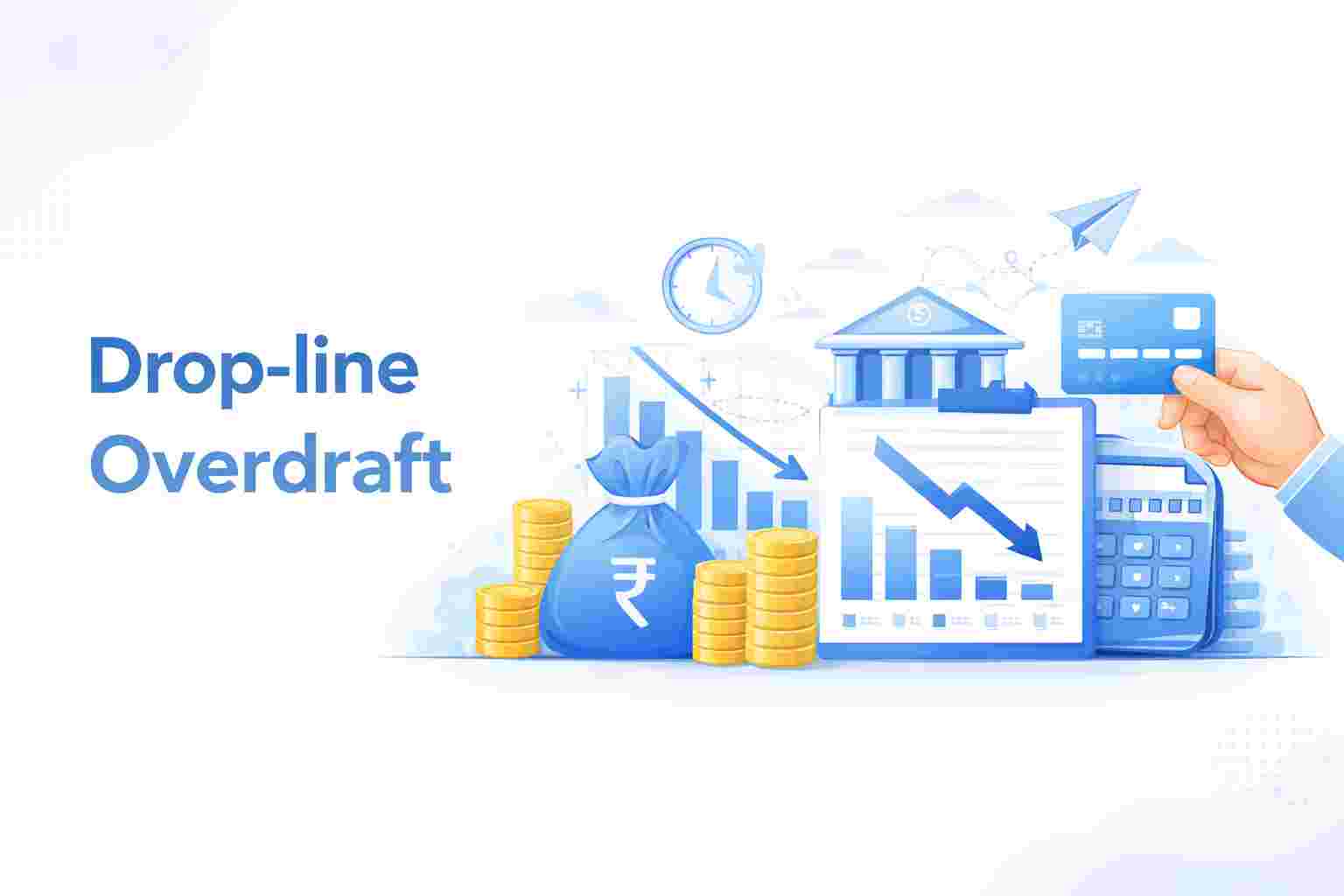

A dropline overdraft is a unique credit facility. It blends the features of a traditional loan as well as a credit card. Your bank grants you access to a credit limit. However, note that the limit gradually decreases each month.
Think of it this way- If you start with a limit of ₹5 lakhs today, your available ceiling drops each month even when you do not touch the money. After a year, you might find your limit has fallen to ₹4 lakhs. This continues until the limit hits zero at the tenure’s end.
The highlights –
It becomes a solid choice if you run a business or need to handle unpredictable cash flows. Only one thing to remember: the more you wait to tap into it, the less money you can access.
A dropline overdraft functions like a revolving fund, but it follows a specific structure.
Here is the simple breakdown of how this works –
Suppose you can get the dropline overdraft facility for ₹5 lakhs over 3 years.
This is what you should expect –
1. Structure as well as Flexibility – It gives you the breathing room to borrow when needed while the “dropping limit” ensures you eventually clear your debt.
2. Fixed Limit & Tenure – The bank decides your total capacity and the time you have to use it. You borrow up to that ₹5 lakh mark initially.
3. Interest on Usage – You do not pay for the whole ₹5 lakhs. If you only take out ₹1 lakh, you only pay interest on that specific ₹1 lakh.
4. Monthly Limit Reduction – Unlike a standard overdraft where the limit stays flat, your ceiling here shrinks monthly. By the end of the first year, your available borrowing power might reduce to ₹3.3 lakhs.
5. Repay & Reuse – You can pay back early to borrow again. As long as you stay under the current month’s limit, you are good to go.
A dropline overdraft provides quick access to cash when you need it. It is an excellent choice for salaried individuals who want funds without the burden of rigid EMIs or high interest rates.
1. Reducing Your Limit – This facility has a fixed tenure. Your total limit shrinks each month until it reaches zero. For example, if you have a ₹120000 limit for about 1 year (12 months), your ceiling drops by around ₹10,000 each month. This forces a bit of financial discipline (which is usually a good thing). You understand how much you can get. This helps you better plan your finances.
2. Pay for the Money You Actually Spend – You are never charged interest on the full sanctioned amount. You only pay for the actual money you withdraw & only for the days you keep it. This makes it a cost-effective safety net for emergencies like medical bills or sudden repairs.
3. Flexible Withdrawals & Repayments – You can withdraw an amount within your current limit as many times as you like. You can also pay it back whenever you want during the tenure. This flexibility is perfect if your income varies or if you rely on bonuses.
4. No Collateral Need for Salaried Individuals – Most lenders offer this to salaried professionals without asking for gold or property as security. They usually just check your salary slips as well as bank statements. It is a great unsecured option when you need speed.
5. Select a Timeline that Works for You – You can pick a repayment term between 1-5 years. A longer term means your limit drops more slowly. You can match this with cash flow, so it does not hamper the monthly budget.
6. A Complete Digital Process – Modern lenders provide the whole process online. You can apply, get approval, and manage your withdrawals through mobile apps.
Here are the benefits of dropline overdraft loan –
Also Read: Overdraft Facility
Here are the differences between a dropline overdraft vs regular overdraft –
| Feature | Dropline Overdraft | Regular Overdraft |
|---|---|---|
| Limit | Your total limit drops a bit every month until it hits zero. | Your borrowing limit stays flat and does not change on its own. |
| Time | You get a fixed term, usually between 1 to 5 years. | There is no set end date. Your bank just renews it every year. |
| Interest Rate | You pay for the cash you actually take out. | You pay for the cash you use, not the whole limit. |
| Repayment | Your limit forces you to pay back what you owe steadily. | You can pay back whenever you want as long as you stay under the limit. |
| Use Case | Great for big, planned life goals like weddings or home repairs. | Better for fixing quick cash gaps or unexpected monthly bills. |
| When to Use | People with a steady income who want a clear exit plan. | Business owners or freelancers dealing with unpredictable income. |
Find out the differences between dropline overdraft vs overdraft vs term loan from this table –
| Parameter | Dropline Overdraft | Regular Overdraft | Term Loan |
|---|---|---|---|
| Repayment | Flexible repayments within a monthly reducing limit. | Flexible repayments with a fixed limit; usually renewed annually. | Fixed monthly EMIs consisting of both principal and interest. |
| Interest Cost | Only on the amount withdrawn for the duration used. | Only on the amount withdrawn for the duration used. | On the entire principal amount for the full tenure. |
| Availability | The main draw is you can reuse funds as you repay. | Funds can be reused up to the static limit as long as you repay. | One-time payout. Once you repay, you cannot borrow again without a new application. |
| Discipline | High discipline due to the “dropline” reducing the limit monthly. | Low discipline as the limit stays the same unless the bank changes it. | Very high discipline since EMIs are mandatory every month. |
A dropline overdraft suits people who want the freedom of a credit line but still want a plan to clear it.
Here is who should consider it-
1. Perfect for Steady Monthly Earners – If you have a steady job, this works as a great safety net for things like weddings or home upgrades. Since the limit drops over time, it helps you avoid staying in debt forever.
2. Great for the Gig Economy – If your income arrives in chunks, you can borrow when you are short and pay it back when a project ends. The reducing limit adds just enough pressure to keep you financially honest.
3. Smart for Managing Business Cash – Managing daily cash flow is hard. A dropline overdraft helps you pay your suppliers or cover quick gaps without needing a new loan every single month.
4. Best for Regular Income Earners – If you get regular rent or commissions, this is a smart way to borrow. You only take what you need and avoid the heavy interest of a standard term loan.
Here is the eligibility criteria –
1. Employment- Salaried or Self-Employed – You need to show you have a steady stream of income from salary slips or business records.
2. Income- ₹20,000/month or more – Most lenders look for a stable monthly income. This figure can change slightly depending on the bank you choose.
3. Credit Score- 700+ Preferred – A strong credit score helps you get a better limit and a lower personal loan interest rate. Meeting the eligibility criteria for personal loan products usually qualifies you here, too.
4. Age- 21–60 years – You must be at least 21 when you apply and no older than 60 by the time the term ends.
Gathering these items beforehand makes everything faster. Most modern lenders prefer digital copies anyway.
Knowing how the costs work helps you use this tool better.
Here is the breakdown –
1. Interest Rates- 10% to 18% Per Annum – The rate depends on the income as well as credit score. If you have a great track record, you will likely land on the lower end of this scale.
2. Repayment Flexibility – There are no mandatory EMIs unless you choose them. You pay back the used amount whenever you want during the term. The monthly limit reduction naturally nudges you to pay it down.
3. EMI Conversion Option – If you use a big chunk of your limit, some lenders let you turn that specific balance into an EMI plan. This makes a large debt much easier to swallow.
4. Pay for Utilised Amount Only – This is the best part. If your limit is ₹5 lakhs but you use zero, you pay zero interest. (Check for any small annual maintenance fees, though).
If you want flexible cash without the headache of a long loan process, follow these steps –
Step 1 – Check Your Eligibility
Use an online platform to see if you qualify. It usually takes less than a minute.
Step 2 – Submit Your Documents
Send over your PAN, Aadhaar, and income proof through the app or website.
Step 3 – The e-KYC Process
Verify who you are with an Aadhaar OTP and a quick selfie. No more waiting for couriers to pick up papers.
Step 4 – Get Your Credit Limit Approved
The lender’s system checks the profile & sets your dropline overdraft example limit based on your earnings.
Step 5 – Access Your Funds Accordingly
Once approved, move money to your bank account whenever you need.
Also Read: Line of Credit
A dropline overdraft, indeed, is one of the most flexible ways to manage your money (if you like having a safety net). It gives you the freedom to spend only what you need while keeping your interest costs low.
Because the limit drops every month, you don’t fall into the trap of carrying debt forever. It is perfect for those who want a structured yet adaptable borrowing option. If you are looking for a digital lending solution that puts you in control, this facility is worth a look. We think it is a smart move for modern borrowers.
Lenders calculate interest only on the daily balance you actually use. If your limit is ₹5 lakhs but you withdraw only ₹50,000, you pay interest only on that ₹50,000. The calculation happens daily, but the bank typically bills you at the end of the month. You never pay for unutilised funds.
You usually pay the interest every month. The lender calculates how much you borrowed and for how many days, then asks for that amount of interest. You do not have to pay back the principal amount each month, like with a regular loan, but you must pay the interest to keep the facility active.
The maximum amount depends entirely on your monthly income and credit history. Most lenders offer anywhere from ₹1 lakh-₹25 lakh or more to salaried individuals. Your bank will set this limit after checking your instant personal loan eligibility and your ability to manage the monthly reducing credit ceiling.
There are two main types- industrial and personal. Industrial ones are for business owners to manage working capital. Personal ones are for salaried employees to handle private expenses. Both follow the same rule where the limit drops monthly, but the eligibility and interest rates might differ based on your specific profile.
The main difference between overdraft and dropline overdraft is the limit structure. The limit stays the same throughout the year. In a dropline version, your limit will reduce every single month. This makes the dropline version more like a loan that you gradually pay off over a fixed tenure.
Download our personal loan app to apply for a personal loan. Get up to 2Lakhs* as a personal loan. Download Now!


Sign into avail a personal loan up to ₹ 2,50,000

Unifinz Capital India Limited is a Non Banking Finance Company (NBFC) registered with the Reserve Bank of India (RBI). lendingplate is the brand name under which the company conducts its lending operations and specialises in meeting customer’s instant financial needs.










 RBI CMS
 RBI Sachet


