
Did You Know?
We serve loans, the best way you can borrow
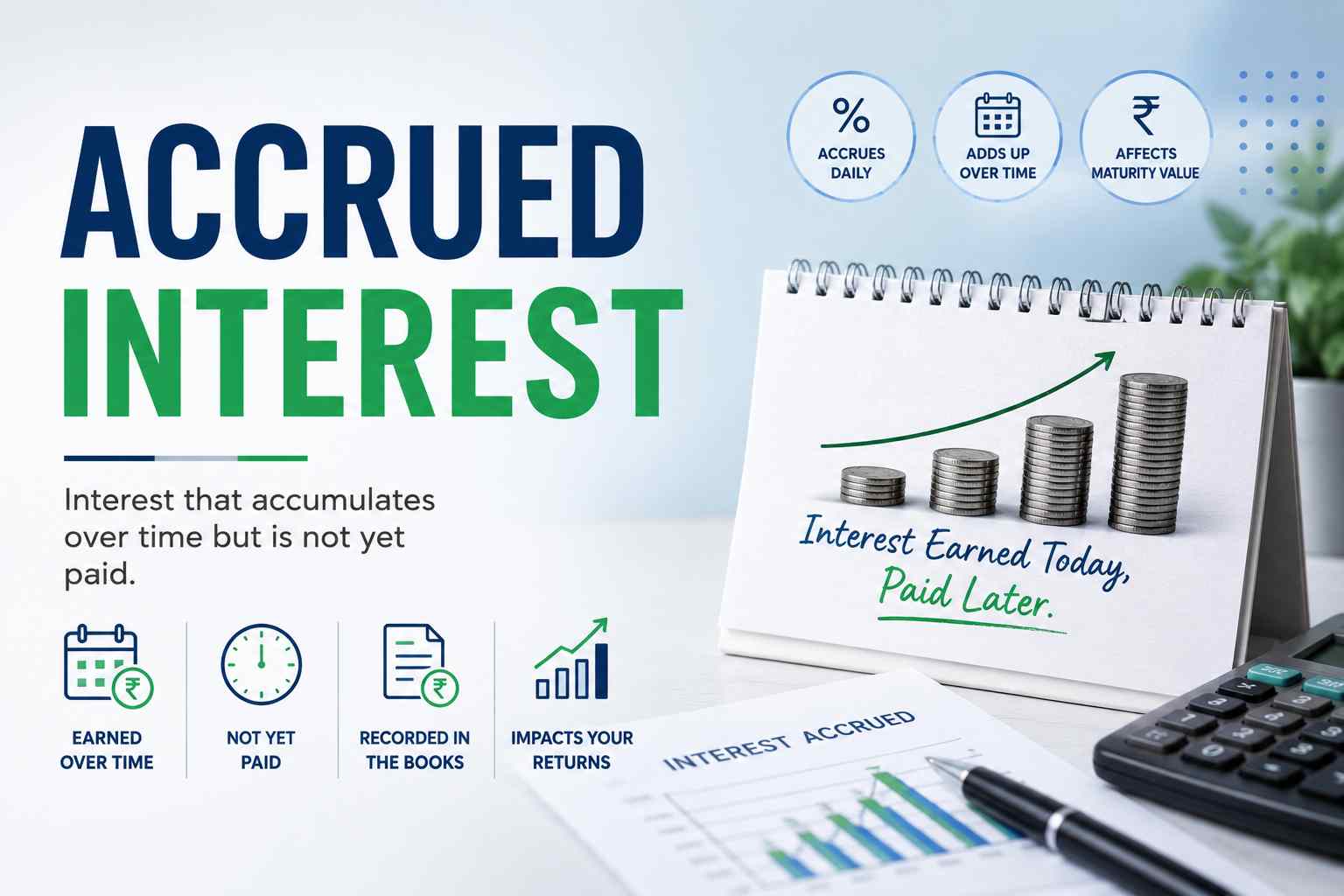

Interest is one of the most important concepts in personal finance and borrowing. Whether you take a loan or invest in bonds or bank FDs, interest is always attached to it. But not many people are aware of the term accrued interest and how it works.
Accrued interest is the interest that is earned or accumulated on a financial product but has not been paid or received. By understanding what is accrued interest, borrowers can get a rough estimate of their outstanding dues, and investors can know the total income they have earned on their investments.
In this blog, we will discuss the meaning of accrued interest, how it builds over time and how it affects your finances.
Accrued interest is the amount that has been earned or incurred over a period of time but is not actually paid or received. The interest typically accrues daily depending on the principal amount and the applicable interest rate.
There are two sides of Accrued interest: –
From an accounting perspective, accrued interest is recorded as either income or expense. If the business lends money, then interest is considered revenue. If it is borrowed funds, then the amount is treated as an expense.
Accrued interest is also recorded in the balance sheet. The outstanding amount that is pending to be received is recorded on the asset side, whereas the amount due for payment is shown as liabilities.
Banks and financial institutions follow the accrual system of accounting. This means they record the expenses when they earn and not when they actually receive cash.
Suppose that you have taken a home loan which has an EMI due on the 5th of every month.
On the 6th of the month, you owe no interest for the new cycle.
But by the 20th, 15 days of interest have been accrued.
Now, if you decide to close the loan on the 20th, then you will have to pay the principal as well as the accrued interest for 15 days.
This explains the process of calculating accrued interest on a loan.
Accrued interest is used across several financial products. Here is how it applies: –
In personal loans, home loans, and business loans, interest starts to accrue from the day the loan is disbursed. The first EMI may start after a few weeks, but the interest continues to accumulate during that period.
Interest is charged on the unpaid balances of the credit card. In case if the outstanding amount is not paid by the due date, then interest will accrue daily until the dues are cleared.
Bondholders get interest over time, even though coupon payments are made only once or twice a year. If the bond is sold before the next interest payment date, the buyer will compensate the seller for accrued interest.
Banks calculate interest on fixed deposits periodically. Generally, this interest is paid at maturity, but it continues to accrue for the entire investment period.
Also Read: Loan Against Fixed Deposit
Savings bank account interest accrues daily, depending on the closing balance, even though the bank may credit it quarterly.
People often get confused between accrued interest and compound interest, but both are different concepts.
Accrued interest is the interest that accumulates on a financial instrument or loan over time but has not been paid or received. It is mostly calculated on the principal amount over a specific period.
Whereas compound interest is calculated on the original principal and also on the previously accumulated interest. Due to this, compound interest grows at a faster rate over time.
Accrued interest helps in determining outstanding dues or earnings, whereas compound interest focuses on the growth of investments or the interest cost of long-term borrowing.
Accrued interest can affect your finances in the following way: –
When you postpone loan payments, interest continues to accrue. This interest will increase the total amount that you have to repay.
When you prepay or foreclose the loan, the outstanding amount that you pay includes the accrued interest up to the date of closure.
Investors in bonds and fixed-income securities should account for accrued interest when buying or selling investments.
Businesses, at times, record accrued interest as an expense or income even before actual payment occurs. This has an impact on their financial statements and cash flow planning.
By gaining the knowledge of how to calculate interest accrued on a loan, borrowers can determine their liabilities and don’t have to face payment surprises.
Accrued interest is the interest that has been accumulated but is not yet paid or received. Whether you are taking a new loan, using a credit card, or investing in bonds, accrued interest will directly affect your financial obligations and returns.
Knowing what is accrued interest can help you estimate borrowing cost, get a proper understanding of investment income and make better financial decisions. It also emphasises the importance of timely payments because delayed payments lead to the accumulation of interest.
By a proper understanding of how accrued interest works and monitoring it regularly, you can manage your loans more effectively and also optimise your investment returns.
Accrued interest is calculated by the following formula:
Principal × Interest Rate × Time
The time period is mostly measured in days or months, depending on the financial product.
The date from which the interest begins to accrue on a loan, bond or investment until the payment date is known as the accrual date.
Lenders charge interest for each day the borrowed amount is due. This is why interest on loans and credit facilities accumulates every day.
No accrued interest has to be paid on a predetermined date, like the EMI date or bond coupon payment date.
Yes. By making regular payments, reducing outstanding balances and prepaying loans, you can reduce the accrued interest.
Accumulated interest is the interest that has been accumulated, but it’s not yet paid. Whereas paid interest means the interest that has already been paid.
When you ask for a loan foreclosure, the lender will also take into consideration the accrued interest up to the foreclosure date in the final settlement amount.
Yes, accrued interest is taxable income in India. It is taxed under the head “Income from Other Sources” in the financial year when it accrues, regardless of whether it has been received or not. This applies to interest from fixed deposits, bonds, and similar instruments.
Download our personal loan app to apply for a personal loan. Get up to 2Lakhs* as a personal loan. Download Now!


Sign into avail a personal loan up to ₹ 2,50,000

Unifinz Capital India Limited is a Non Banking Finance Company (NBFC) registered with the Reserve Bank of India (RBI). lendingplate is the brand name under which the company conducts its lending operations and specialises in meeting customer’s instant financial needs.




















 RBI CMS
 RBI Sachet


