
Did You Know?
We serve loans, the best way you can borrow
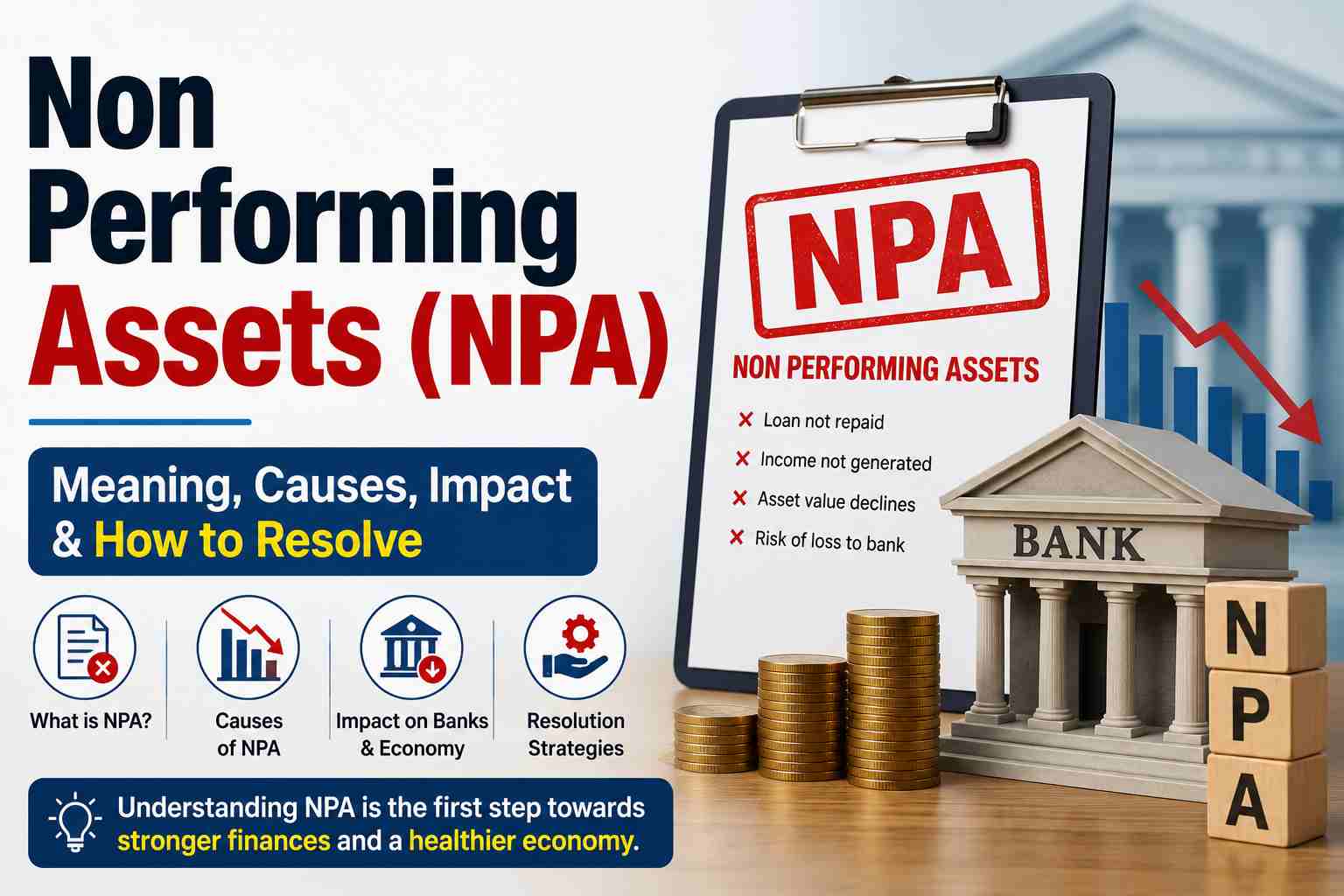

It represents an advance or loan made by a financial entity that ceases to yield revenue to the lender. When you fail to pay your interest or principal installments for a continuous period of over 90 days, your lender formally labels the account under this specific category.
This classification directly harms the institution because your unpaid loan halts its primary cash inflow. The recovery probability drops significantly as the delinquency time stretches further. Every credit format, including your housing finance, commercial loans, or massive infrastructure funding, falls into this category if your repayments stop.
The Reserve Bank of India introduced this 90-day benchmark in 2004 to align domestic banking policies with international regulatory frameworks. The moment your loan receives this tag, the lending institution must monitor it rigorously, initiate statutory recovery actions, or remove it from its balance sheets.
A non-performing asset scenario involves a credit account for which you have completely stopped your regular principal or interest payments. These specific defaults possess unique operational attributes that clearly separate them from your standard, well-performing loan accounts.
Understanding what is meant by a non performing asset helps you see how credit defaults operate in daily business cycles. When you secure financing from an institution for personal use or corporate expansion, you promise to return the funds through scheduled monthly payments.
If your payments are delinquent for 90 days, the institution changes your account status to a bad asset on its books. This change initiates a difficult financial cycle in which the lender immediately loses the interest income it expected. They must label your account as a high-risk element, which damages their structural balance sheet stability.
An accumulation of these bad accounts reduces the institution’s capacity to approve instant personal loans for other consumers. Their operational capital remains stuck in non-earning accounts, forcing eventual credit write-offs if your recovery looks impossible. Your single default alters the institution’s broad lending power and damages public trust.
Financial institutions evaluate a non-performing asset ratio in accordance with strict accounting and asset identification rules set by the central bank. They determine your institutional stress through the Gross NPA metric, using a standard mathematical approach.
GNPA = (Total NPAs / Total Loans and Advances) × 100
The total bad-loan value covers the unpaid balance of all individual credit accounts that crossed the 90-day payment threshold.
Consider a scenario where you borrow Rs 1,00,000 from a credit provider with a 12-month repayment timeline and a 10% interest rate. If you miss your very first monthly installment and fail to make any payments for the next three months, your account changes status.
The lender flags your debt account as a bad asset because your default exceeds the 90-day regulatory threshold. This scenario serves as one of the clearest non performing assets examples in retail banking operations.
The institution then chooses between two distinct operational paths-
A single missed monthly payment can alter your credit classification, underscoring the need to closely monitor your payment timelines.
Lenders classify their bad debts into distinct groups depending on how long you have delayed your scheduled loan repayments. You can understand the breakdown of types of non performing assets through three major institutional categories.
Bad debts do not develop without specific operational triggers (economic shifts or personal financial distress usually drive them). Multiple structural elements can push your standard loan into default territory, and the common causes include-
Lenders monitor these metrics closely because they reflect the institution’s actual financial stability and operational health. A high concentration of bad loans reveals that a major portion of the lender’s capital is not earning returns.
This situation harms institutional profits, reduces cash reserves, restricts credit expansion, and erodes investor trust in the business setup. The capital adequacy ratio (the metric tracking an institution’s survival cushion) drops when your default numbers rise.
Tracking these balances helps institutions adjust their lending criteria, verify your personal loan documents strictly, and prevent future capital damage. The default ratio acts as a transparent guide for regulators and depositors to judge how well an institution manages its risks.
Lenders cannot afford to leave defaulted accounts unattended, so they deploy specific recovery strategies the moment you miss payments. They utilise distinct mechanisms to manage bad debts-
When your loan turns into a bad asset, financial institutions must account for the financial hit by using provisioning methods. This accounting process means the institution sets aside a portion of its operating profits to offset your unpaid loan.
This strategy ensures the lender presents an accurate picture of its earnings without risking sudden insolvency from bad debts. The central bank dictates the exact provisioning percentages you must follow based on the asset class and default period. Proper allocation helps institutions keep their books balanced and maintain market trust.
Institutions use two separate metrics to measure the exact volume and depth of their bad debt problems.
Lenders convert these figures into percentages to check the risk profile of their overall credit portfolio. A high net ratio means the institution lacks a sufficient capital cushion to survive your defaults.
The Gross NPA Ratio shows the proportion of total advances that have turned bad before safety deductions.
Formula- Gross NPA Ratio = (Gross NPAs / Gross Advances) × 100
The Net NPA Ratio measures the remaining bad debts relative to net advances, indicating the direct strain on business income.
Net NPA Ratio = (Net NPAs ÷ Net Advances) × 100
Regulators check both ratios because high ratios indicate weak asset selection, elevated risks, and impending regulatory restrictions.
Separating and labelling bad debts might look counterproductive, but this systematic asset division helps financial institutions in several ways-
Bad debts damage more than just institutional ledger books (they create a heavy impact of non performing assets across the financial network).
Unpaid debts create significant operational difficulties for both the borrower and the lender.
When your account is marked as a bad asset, it shows that you cannot meet your financial obligations. This specific default stays on your credit report for years, telling every future lender that you abandoned a debt obligation. This classification damages your credit score, which serves as the primary three-digit measure of your financial reliability.
Consequently, financial firms will reject your applications when you try to get a car loan or credit card. Any future credit you secure will carry much higher interest rates due to your damaged credit history.
Holding bad debts on balance sheets creates severe operational blockages for financial institutions. Your missed principal and interest payments reduce their cash flow, breaking their operational budgets and cutting corporate profits.
Loan loss provisions eat into the capital reserves that the institution needs to fund new loan applicants. Once the institution confirms you can never repay the debt, they write off the loss directly against their earnings.
Bad debts damage the broader financial landscape by restricting credit availability and forcing lenders to trap their capital in reserves.
Loans are supposed to generate regular interest income for your bank, but bad assets can completely stop this revenue stream. The bank must set aside financial reserves to cover its defaults, which reduces net profit margins, lowers capital efficiency, and dampens its willingness to lend.
Asset quality in India has improved recently, and official reports show that public sector lenders recorded a steady decline in Gross NPAs over FY21-FY25, driven by improved credit tracking.
Higher bad debts mean lower financial returns for your portfolio, as provisioning eats into the bank’s distributable profits. It reduces corporate growth plans and causes sharp movements in equity prices. These defaults pose a direct credit threat to your fixed-income securities, increasing cash flow stress and causing delayed bond payments.
Lenders become highly conservative when their bad-asset ratios rise. They tighten eligibility requirements, delay loan approvals, and raise interest rates to protect themselves, which slows consumer spending and halts business expansion.
You must use smart financial strategies to keep your name off the institutional loan defaulters list.
Lenders use multiple administrative paths to recover their funds when your account turns into a bad asset.
When you struggle to manage your debts, lenders can restructure your loan terms to protect their cash flow and avoid bad asset tagging. If you backed your loan with collateral, the lender can seize and auction that asset to cover the unpaid balance.
Lenders can also convert your corporate debt into equity shares, hoping the stock value rises enough to cover the default losses. Companies facing bond defaults can convert their bond debt into equity shares if they cannot pay investors, which dilutes original share values.
Lenders also sell your unsecured bad debts at steep discounts to collection companies when traditional recovery routes cost too much time and money.
Non-performing assets are loans or advances held by financial institutions that are no longer generating active revenue. When you secure credit but fail to pay interest or principal components, the account loses its performing status. This classification means the lender’s capital is tied up, forcing them to record the asset as a non-earning liability on their official accounting sheets.
A loan receives this classification the moment you fail to service your financial obligations for a specific period. For standard commercial or retail credit, the threshold is 90 days of continuous non-payment. Once your interest or principal installment is overdue for more than this three-month window, the financial firm changes your loan status from standard to non-performing.
Your loan is moved to this bad-asset category after 90 days of continuous default under standard banking rules. Financial firms previously used older timelines, but current guidelines enforce the 90-day limit to align with global practices. If you miss your payments for more than three months, your lender marks the account as non-performing.
Financial institutions sort these bad debts into three groups based on the timeline of your payment default. Your account is considered a substandard asset if it remains overdue for up to 12 months. It becomes a doubtful asset after crossing the 12-month default mark, and turns into a loss asset when recovery looks impossible.
Banks classify your defaulted loans based on the total duration your payments have been overdue. They track your account through specific risk stages, progressing from substandard to doubtful over time. If your financial institution or internal auditors determine that the outstanding balance cannot be recovered, they reclassify your debt account as a permanent loss asset.
Lenders handle these bad debts by deploying systematic legal and administrative recovery processes. They try restructuring your debt first by extending your repayment tenure or modifying interest rates. If you fail to respond, they use the SARFAESI framework to seize collateral, move to debt tribunals, or sell your debt to asset reconstruction firms.
The moment your loan becomes a bad asset, your lender stops including its unpaid interest in its profits. They launch formal recovery actions, report your default to credit bureaus, and block your future loan approvals. This classification damages your credit score, making it very difficult for you to secure affordable credit options later.
Institutions calculate this by comparing the total number of defaulted loans with their entire portfolio of advances. They divide the total value of accounts overdue for 90 days or more by their gross credit distributions to get the Gross ratio percentage. They subtract allocated provision funds from bad debts to calculate the precise Net ratio percentage.
Bad debts pose a severe threat because they hit the lender’s profitability and drain cash reserves. When you default, the institution loses expected interest revenues and must lock up its own profits in provision funds. This situation limits their capacity to offer new credit lines, damages market image, and invites strict regulatory penalties.
You can remove this tag by paying off your total overdue principal and interest amounts to clear the default. Lenders remove the bad asset label and restore your account to standard status once you settle the dues. Alternatively, institutions clear these accounts by settling debts for a lump sum or writing them off entirely.
Download our personal loan app to apply for a personal loan. Get up to 2Lakhs* as a personal loan. Download Now!


Sign into avail a personal loan up to ₹ 2,50,000

Unifinz Capital India Limited is a Non Banking Finance Company (NBFC) registered with the Reserve Bank of India (RBI). lendingplate is the brand name under which the company conducts its lending operations and specialises in meeting customer’s instant financial needs.





















 RBI CMS
 RBI Sachet


