
Did You Know?
We serve loans, the best way you can borrow
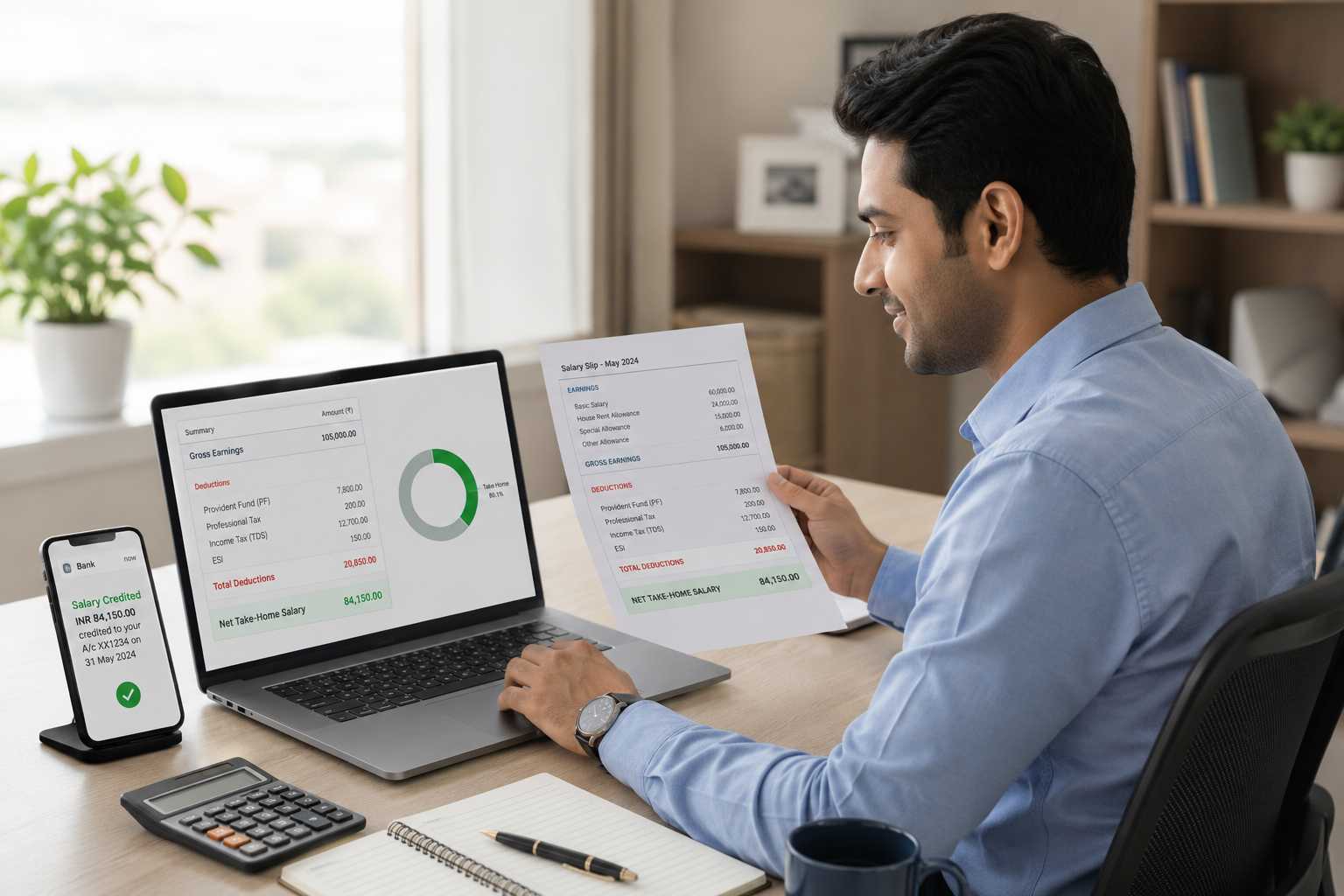

When you get the first job offer, the first thing you see is the salary package. The confusion starts later on, as the amount mentioned on the offer letter and the actual amount credited to your bank account are quite different. This is why it’s important to know the concept of in-hand salary.
Fresher employees generally get confused by terms like CTC, gross salary, and take-home salary. By a proper understanding of these terms, you can handle your expenses, savings and take in a better way. It can also help you negotiate your salary package effectively.
In this blog, you will get a clear picture of CTC, in-hand salary and gross salary. You will also get to know how to calculate in hand salary from CTC, which will help you make better career and financial decisions.
In-hand salary, which is also known as net salary, is the amount that an employee receives in their bank account after all mandatory deductions from gross salary. It is also called take-home salary. CTC (Cost to Company) reflects the total yearly cost an employer bears for employee services, whereas in-hand salary reflects the disposable income that one can spend and save.
Suppose your monthly gross salary is ₹50,000. Mandatory deductions like EPF, income tax amount, professional tax, etc., come to ₹9000. Then your monthly in hand salary will be ₹41000.
Let us understand how CTC, Gross salary and Net salary differ.
CTC is basically the total amount spent by a company on an employee in a year. It is the total annual salary package of an employee, which includes salary, employer’s PF contribution, insurance, gratuity, etc. In addition to this, it includes additional perks like subsidised meals and transport.
Gross salary is the amount that you see on your offer letter before any taxes or deductions. Basic salary and all types of allowances are included in it. However, employer contributions are excluded.
Net Salary is the actual amount received by an employee in the bank account after all kinds of deductions like tax (TDS), Provident fund (EPF) and statutory deductions from gross salary.
Also Read: Net Monthly Income in Loan
As per the 2026 Labour Codes, the Indian salary structure has become very standard. There are several components of this salary structure, which are as follows: –
The basic salary is a fixed pay component of the salary and is generally 35%-50% of your overall salary package. It is fully taxable and is base for the calculation of PF and Gratuity.
Employers provide a house rent allowance to help employees meet rental expenses. It is partially tax-exempt if you live in a rented house.
Any additional payments that the company made and it don’t fall under other categories are called special allowance. It is fully taxable.
It provides compensation to employees for their own and family travel expenses. Tax relief is available for leave travel expenses.
Performance bonuses and annual incentives are a part of the compensation package, and it is fully taxable.
The employer’s contribution to EPF is included in your CTC, but it is not part of your take-home salary.
Many organisations include gratuity in their CTC. However, employees generally receive gratuity only after completing a specific term in the company.
By proper knowledge of these components, you can properly calculate in hand salary after tax and understand your compensation structure.
Also Read: How To Get Personal Loan Tax Benefits?
Many employees are shocked when the salary credited to their bank account is less than their gross salary. This is because of the following components: –
A portion of your salary is contributed to the EPF account every month. It is generally 12% of your basic salary.
Tax deduction depends on your income and the tax regime you select. In 2026, the new tax regime will become the default, which has a higher standard deduction.
Certain states levy a professional tax on salaried individuals. It has a capping of ₹2,500 per year (approx. ₹200/month).
This is only applicable to employees who are earning below a certain limit. They get medical benefits from the Employee State Insurance.
Also Read: Gross Income
Here are certain tips that can help you increase your take-home salary: –
You can request your employer to include tax-saving components in your salary. This includes HRA, meal coupons and reimbursements. These components can reduce your taxable income and can help increase your take-home salary.
India offers new and old tax regimes, and both have their own benefits. You shall compare your deductions and tax liabilities under both options and then select the one that gives you a higher in-hand salary.
When the employer is finalising your compensation package, you shall ask for its breakdown. A properly structured salary with tax-friendly allowances will help you get a better take-home income.
Standard deduction for PF is 12%, but certain companies do allow you to restrict PF deduction to the statutory limit, i.e. ₹15,000. This can increase your monthly take-home salary.
Also Read: Loan on PPF Account
You can invest in tax-savings instruments, which will reduce your overall tax burden. Lower tax means there will be fewer deductions from your salary. This means you will get a higher amount.
Your CTC may be high, but your in-hand salary is what matters the most. It is the amount that is credited to your bank account after various deductions. It determines how much you will spend and how much you will save. Your daily expenses depend on your take-home salary.
Hence, before you accept the job offer, properly calculate in hand salary from CTC. It will give you the exact amount that you are going to take home. Clear all your doubts about deductions from the employer. You can also ask to include certain components to increase your take-home salary.
In-hand salary is the final amount that is credited to your bank account after mandatory deductions from gross salary. The deductions include taxes, EPF contributions, PF, etc.
This is because CTC has various benefits and contributions that are not in direct cash form. This includes employer PF contribution, gratuity, insurance premiums and other benefits. These are the expenses that are paid by the company for you but are not part of your monthly income.
CTC is the overall cost that the employer incurs on an employee, and gross salary is the amount before deductions. In-hand salary is the final amount you receive after all deductions.
Some of the common deductions that affect in-hand salary are income tax, employee provident fund, professional tax, insurance premium and company-specific deductions.
You can increase the take-home salary by choosing the correct tax regime, changing voluntary deductions, choosing a tax-efficient salary structure and investing in eligible tax-saving instruments.
A higher basic salary means there will be an increase in EPF contribution and certain allowances. Hence, it can impact your take-home salary.
EPF contribution and income tax reduce the final amount that will be credited to your bank account. Hence, it reduces your take-home pay.
As per the income tax rules, salaried employees in India are eligible for a standard deduction of ₹75,000 under the new tax regime. This will reduce their tax liability and increase their take-home salary.
In-hand salary is calculated by subtracting deductions such as Provident Fund (PF), Professional Tax (PT), Income Tax (TDS), Employee State Insurance (ESI), and other applicable deductions from your gross salary. The amount remaining after these deductions is your in-hand salary, which is credited to your bank account each month.
Formula:
In-Hand Salary = Gross Salary − Total Deductions
Download our personal loan app to apply for a personal loan. Get up to 2Lakhs* as a personal loan. Download Now!


Sign into avail a personal loan up to ₹ 2,50,000

Unifinz Capital India Limited is a Non Banking Finance Company (NBFC) registered with the Reserve Bank of India (RBI). lendingplate is the brand name under which the company conducts its lending operations and specialises in meeting customer’s instant financial needs.



















 RBI CMS
 RBI Sachet


