
Did You Know?
We serve loans, the best way you can borrow
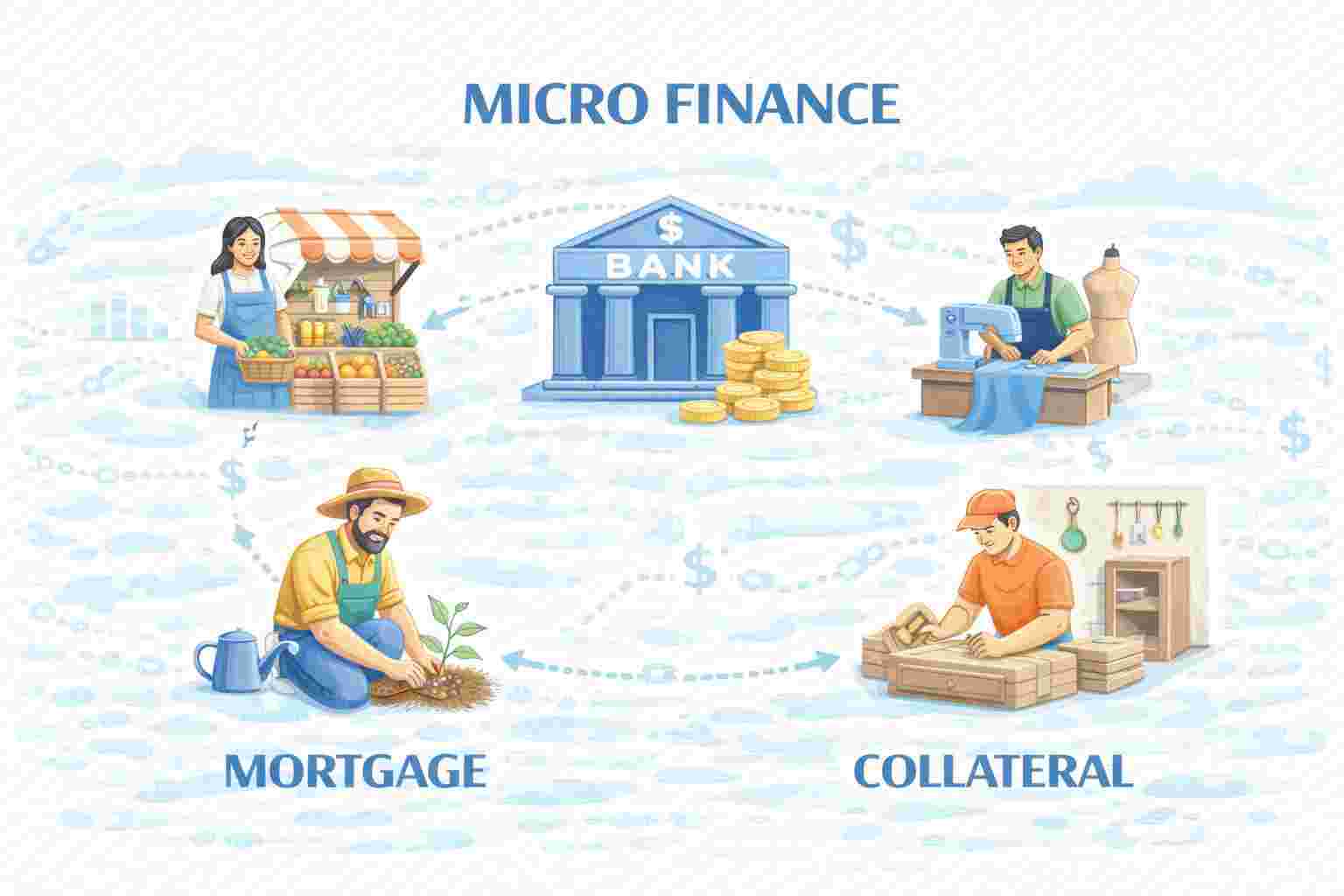

The meaning of micro finance is simple. It brings banking services to people who cannot access traditional financial systems. Everyone has personal goals that need money. Loans, savings and other services help meet those goals. But the bigger impact is on the economy. Money moving in the market keeps businesses alive and jobs active.
The problem starts when many people cannot use these services. Micro finance means that financial services are offered to people with low income or groups who are typically excluded from conventional banking.
Growth slows down and families struggle. Traditional banks often set tough conditions. Low-income earners fail to qualify and remain outside the financial system. Micro finance changes this. It gives access to money, savings and guidance.
This blog will explain what micro finance is, why it matters, its benefits and how it works for you.
So, what is meant by micro finance? In simple words, it is the set of financial services made available to people who cannot reach traditional banks. These services include instant personal loans, savings and insurance. In India, this support is offered mainly by microfinance institutions, often called MFIs.
The way these institutions work looks a lot like banks and NBFCs. The difference is that MFIs focus on the needs of low-income groups. Instead of large sums, they provide smaller, manageable amounts that match the financial ability of borrowers.
The Reserve Bank of India sets the income cap for people who can use microfinance services at ₹3 lakhs. This is important because many formal institutions still prefer clients with higher incomes. For people with lower wages, that barrier locks them out.
Also Read: RBI Approved Loan Apps in India
Because of these benefits, more people are choosing micro finance as a practical solution. It not only helps individuals but also adds to economic progress. Even large banks and NBFCs now recognize its value and offer simple services to reach a wider base of customers.
Two main models explain how micro finance works in practice.
1. The first is an individual model. Here, services are provided directly to small business owners or entrepreneurs.
2. The second is a group model. In this setup, a few people join together to apply for a loan as a unit. Single borrowers may qualify for only a small amount. Thus joining a group lets them get access to bigger loans.
Both models give people without access to banks a fair chance to borrow and build stability.
Micro finance can be traced back to the 1980s. Bangladeshi entrepreneur Muhammad Yunus created microcredit. He also established the Grameen Bank. He wanted to give people a chance to borrow a modest amount so that they could improve their income flow.
The vision came after Yunus saw women earning barely two cents a day making bamboo stools. He believed that with a small loan, they could increase profits and live better. He lent them $27 as a group loan. They not only repaid it but also kept their work going with more stability.
Soon after, microcredit began to include small savings too. Borrowers could set aside part of their income as a condition of the loan. This protected lenders and helped borrowers build savings for the future.
In 2006, Yunus received the Nobel Peace Prize for such a contribution. Grameen Bank grew to thousands of branches and inspired the rise of nearly 10,000 micro finance institutions worldwide.
Here are the features of micro finance:
One important feature of micro finance is that most lenders do not ask for collateral. This makes it easier for people with limited assets to access money when they need it most. For many first-time borrowers, this is the only way they can secure funds.
Borrowers are usually small business owners or individuals with low income. The objectives of micro finance are to provide financial help to those who are often excluded from banks & encourage new entrepreneurs to start or grow their work.
Loan amounts are usually small. They depend on the type of business or location. The smaller amounts are more manageable. They match your capacity to repay on time without putting an additional burden.
Micro finance supports individuals as well as small businesses. It offers entrepreneurs the push to start & grow their ideas. At the same time, these entrepreneurs can help families meet basic needs with this financing. The funds create a foundation for long-term growth.
Conventional banks often deny loans to people without assets or a stable income. Micro finance offers loans to groups that earn low income or small business owners. This is valuable in rural as well as underserved areas where bank availability is limited.
People become financially independent at one point in time. When this happens, their ability to repay loans improves. Micro finance institutions offer repayment terms that are flexible. It helps borrowers repay without any pressure. In fact, women entrepreneurs benefit from this.
In rural families where income is limited, children are often forced into work instead of school. Micro finance helps manage home expenses so they can consider children’s education. It improves opportunities for the future while helping break the poverty cycle.
Small businesses often struggle to cover daily costs, leaving no room to think about expansion. With the help of micro finance, they can manage essentials and later plan for investments to grow their business. Since loan terms are more manageable than those of traditional banks, entrepreneurs can work with less stress.
Funding small businesses helps businesses expand or hire more people. These new jobs offer income for families while strengthening communities. They also drive financial activity in local areas. This is most significant in rural regions with limited job opportunities.
Many low-income families live under constant money stress. Micro finance offers small, manageable loans that help cover household needs and operational costs. Instead of falling into high-interest debt traps, micro finance personal loans give financial relief while focusing on improving borrowers’ financial health.
Different forms of micro finance serve the unique needs of low-income groups and small entrepreneurs. Each type has its role in supporting financial inclusion and creating stability for people who lack access to traditional banks.
Microcredit is one of the most common forms of micro finance. It involves providing small loans to individuals or families who cannot borrow from banks. A farmer may need funds to purchase seeds or equipment for the season. Such loans are usually small. They make a big difference in daily survival as well as growth. Interest rates can vary depending on operational costs.
Check Out: lendingplate’s Personal Loan Interest Rates
Microloans are short term loans offered in small amounts. They help individuals manage small businesses while keeping cash flow steady. One can be a trader or a woman entrepreneur. Anyone earning a minimum amount can be considered. The goal of these loans is to support self-employment and encourage socio-economic development.
Microinsurance protects people against such unexpected events. Unlike regular insurance, it comes in smaller, affordable packages. It may cover health needs or a sudden financial shock. This type of micro finance is for workers in agriculture or the informal sector when challenges arise.
Saving money feels impossible with a limited income for many households. Microsavings accounts let people deposit even small amounts. They help them build the habit of saving. These accounts do not usually require any minimum deposit or extra charges. Saving in small steps lets families prepare for emergencies.
In India, micro financing operates through two main channels that bring financial services closer to people who are often left out of the banking system.
It was started by NABARD in 1992. This programme focuses on women with a low income. They form small groups of 10 to 15 members. Members from this shared fund can borrow money whenever they need it.
MFIs are dedicated organisations offering –
1. Small Loans
2. Insurance
3. Bank Accounts
4. Remittance Solutions
They borrow money from larger financial institutions. Then, they lend it to individuals or groups at affordable terms. Many MFIs operate on the Joint Liability Group model. Here, around 4-10 members form a group & apply for loans together.
Micro finance institutions are organisations that offer small loans & basic financial services to people who cannot access banks –
A Joint Liability Group is a small unit of 4-10 members. It usually includes farmers, landless labourers, tenants, etc. The members apply for loans together. Their collective guarantee makes it easier for those without collateral to access funds.
Also Read: The Role of Collateral for Loans
Self-Help Groups bring together people from similar economic backgrounds who save regularly and build a common fund. Members can borrow from this pooled money to meet personal or business needs. Many such groups can also access loans from banks if they maintain a track record under NABARD’s SHG-Bank Linkage Programme.
The Grameen Bank Model was introduced in Bangladesh in the 1970s. It focuses on supporting people with low incomes through small loans. It inspired the creation of Regional Rural Banks in India. This further extends financial solutions to households that are economically weaker.
Rural cooperatives were among the earliest microfinance forms in India. It was set up around the time of independence. They were designed to pool resources from individuals with low incomes. They offer basic financial services.
Microfinance institutions play a key role in making financial services more inclusive. Their work isn’t limited to giving out loans. They focus on building stronger communities.
Here’s what they typically do:
1. Help communities grow sustainably by offering access to credit and savings facilities.
2. Provide financial and social support to low-income groups, often working with NGOs and local organisations.
3. Develop solutions that remove financial barriers, so small businesses and individuals can access funds more easily.
4. Create self-employment opportunities for people with limited income, helping them move toward independence.
5. Offer training and skill development for rural entrepreneurs, improving productivity and employability.
6. Support self-help groups & community-based models that drive local economic development.
So, these institutions give people the tools to shape their own financial future, while also strengthening the communities around them.
Micro finance has transformed the way underserved communities access money, save, and invest in their future. Supporting small businesses & creating jobs can drive real social and economic change. With continued growth, microfinance will remain a vital tool for inclusive development worldwide.
Some critics point to high interest rates and the risk of people borrowing more than they can handle. Others say its impact is overstated. It helps, but it’s not an easy solution for poverty. Still, when managed responsibly, it creates meaningful opportunities.
Your household income, as well as your financial background, are two important things when it comes to eligibility. Families in India who take the loan must earn up to ₹3 lakhs a year. Lenders may also check if you are part of a group or have basic savings before approving your loan.
Check Out: lendingplate’s Personal Loan Eligibility Criteria
You do not need to go through a pesky list of paperwork. You only need your Aadhaar card/voter ID, or ration card. Some lenders may ask for address or income proof. The whole idea is to keep documentation simple.
Microfinance loans offer a financial push. Many people use them to start a small shop. One can use it to buy some essentials or invest in farming. Alternatively, these loans help fund a home business. A few lenders give these loans for education or healthcare expenses, considering the income stability of the individual.
Repayments become stressful if someone takes on too many loans or struggles with irregular income. Sometimes loans are spent on miscellaneous needs. That may reduce the impact. This is the reason why guidance & responsible borrowing are important.
Download our personal loan app to apply for a personal loan. Get up to 2Lakhs* as a personal loan. Download Now!


Sign into avail a personal loan up to ₹ 2,50,000

Unifinz Capital India Limited is a Non Banking Finance Company (NBFC) registered with the Reserve Bank of India (RBI). lendingplate is the brand name under which the company conducts its lending operations and specialises in meeting customer’s instant financial needs.
















 RBI CMS
 RBI Sachet


